Frederick Douglass Quotes
The story of our inferiority is an old dodge, as I have said; for wherever men oppress their fellows, wherever they enslave them, they will endeavor to find the needed apology for such enslavement and oppression in the character of the people oppressed and enslaved
Frederick Douglasss, ~1817-1895, Abolitionist & Editor, Recorder of Deeds, District of Columbia, U. S. Minister to Haiti, Speech, Annual Meeting of The Massachusetts Anti- Slavery Society, Boston, April 1865
Sourced by: Eigen's Political and Historical Quotations

Parker and other escaped slaves in Christiana fought off slave catchers and killed the slave owner leading them. Charged with treason, he escaped to Canada with his family and lived there the rest of his life. While not a polished writer, after he himself had escaped and went to Christiana and leaned to read and write. He wrote this narrative of his life as a slave—one of the few written works we have from slaves.


Miller was the first Black American admitted to a Graduate Program—Johns Hopkins—in Mathematics

This statement was made long after slavery had been abolished and Jim Crow was on the rise in the South.

The President often referred to this statement as an example of his wife’s acumen. She had been born to a Southern plantation and inherited the land and the slaves. Her view, and his, were typical of the Southern point of view in early America.


_0_thumbnail_47x47.jpg "A portrait of Richard Allen, a Methodist bishop and founder of the African Methodist Episcopal Church")
Many whites thought that the solution to the problem of free and emancipated Negroes was to send them to Africa. They assumed that the negroes would by desirous of that solution also, but they rarely asked them. When they did, they received answers much like this one from one of the leading Black clergymen in America.

Many social scientists believe that this is one of the reason for so much racism amongst the lower class whites. If blacks are “below” them, the poor whites have power and are not at the bottom of the sociological pyramid of society. To many this is better than being better off themselves but starring the bottom with the Negroes.


The highway was planned to go through a poor neighborhood which had a high percentage of Black residents—all of whom would have to find other housing and move to make room for the highway. If the government plans a highway through a wealthy area, the cost to condemn and pay for the land will be much greater than if a poor neighborhood is acquired. For urban highways, the poor almost always bear a disproportionate share of the inconvenience while the major benefit inures to the wealthy and middle class. Abbot had been a labor organizer and a professional artist before he entered politics. The graphic is of his famous poster which by itself stopped the plans to build the highway very quickly.


For more about the Bureau. See {629185}.and {629187}.


What is interesting is that when he cites the dreadful facts about American slavery, he never points out that the American slave traders rarely raided the villages and captured the slaves themselves. Most often this was done my Khamenei’s Muslim brethren slave traders who dominated the slave trade in Africa. Nor does he point out what after realizing the evil that Americans perpetrated with slavery, we ended it in the 1860s. Saudi Arabia, the central nation of Islam, did not make slavery illegal until 100 years later, and even today, there are many Saudi’s who get caught practicing slavery with household servants and forms of indentured servitude. And while Christians and the Bible tolerated slavery, the Koran and the Prophet never once condemn the practice of slavery. Democracy at any point in time is not always morally right, but it is a process by which under pressure from the people it improves over time because the people can change it and do.

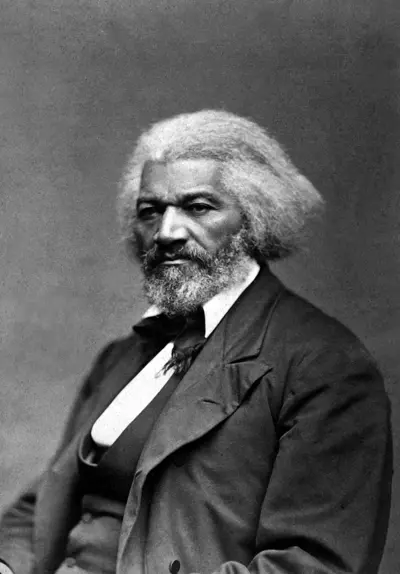
Frederick Douglass was an American social reformer, abolitionist, orator, writer, and statesman. After escaping from slavery in Maryland, he became a national leader of the abolitionist movement in Massachusetts and New York, becoming famous for his oratory and incisive antislavery writings. Accordingly, he was described by abolitionists in his time as a living counterexample to slaveholders' arguments that slaves lacked the intellectual capacity to function as independent American citizens. Likewise, Northerners at the time found it hard to believe that such a great orator had once been a slave.
