Richard Furman Quotes
The right of holding slaves is clearly established by the Holy Scriptures, both by precept and example. In the Old Testament …. Had the holding of slaves been a moral evil, it cannot be supposed, that the inspired Apostles, who feared not the faces of men, and were ready to lay down their lives in the cause of their God, would have tolerated it, for a moment, in the Christian Church …. The Christian golden rule, of doing to others, as we would they should do to us, has been urged as an unanswerable argument against holding slaves. But surely this rule is never to be urged against that order of things, which the Divine government has established.
Religious establishments by and large supported early American slavery. Quakers and some of the Northern established churches opposed slavery, and in the 1850’s Protestant opinion began to turn against slavery with the exception of the Southern Baptists. The Catholics—themselves the objects of major discrimination—chose not to alienate themselves moreso, supported slavery but not with great fervor. Rev. Furman is the man for whom Furman University is named.
Richard Furman, 1755-1825, Minister & President of the South Carolina Baptist State Convention, Religious reasons to support slavery, Exposition Of The Views Of The Baptists, Relative To The Coloured Population In The United States In A Communication To The Governor Of South-Carolina May 28, 1823
Sourced by: Eigen's Political and Historical Quotations


This appears to be one of the first religious groups to withdraw and separate from a state church.

In what may have been amongst the lowest intellectual discussions regarding religion, the mores of the time was that slaves belonged to the slave owners and just as the owner had all power over the slave, he could also select the religion of the slaves as well. From a Christian point of view, freedom to be a Christian was critical, so what was to be the position and law regarding non-Christian slave owners, especially the Jews. Should property rights be dominant as was the tradition or should the Church have the right to dictate the religion of slaves? At no point in the discussion was the possibility even considered that the individual slave might have the right to select his/her religion. As a practical matter, at the time there were relatively few Jewish slave-holders, but as the Jews integrated into Christian society many assimilated—especially the wealthy who also traded and bartered with slaves. Muslims were not a problem as the newly emerging religion prohibited Muslims from holding other Muslims as slaves—although Christians and Jews could be held in servitude and were.


Kennedy was being hurt be fears that as a Catholic, he would be beholden to the Pope and the Catholic Bishops. There were many protestants who believed that the Catholic Church was antithetical to democracy and some who even believed that Catholicism was the religion of Satan. Kennedy decided to confront the issue head on.


Backus was the first of the American clerics to espouse the position that in order for there to be a Christian nation, the state must be separate from the Church.


Samuel Langhorne Clemens, 1835-1910. This viewpoint of Twain’s was just too jarring for an English newspaper to publish as England had been the leading Christian missionary nation in the 19th century. In the 20th century United States parents had a taste of Twain’s description with the Krishna’s, Scientologists, and other religions or cults doing what Christian missionaries had done elsewhere.


Since all of God’s Truth was in the Bible, any other book was at best unnecessary and at worst blasphemous. The German practice of book burning seems to have started here in Munster. The exact same logic was used by Islamic Caliph Omar I in deciding to burn the great Library of Alexandria. See {627584}


American Catholic bishops were divided during the Civil War over the slavery question. For a bishop’s view opposing abolition of slavery, see Hughes {611579}.


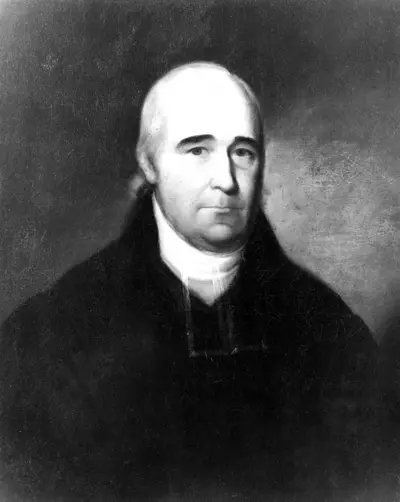
Richard Furman was a Baptist leader from Charleston, South Carolina, United States. He was elected in 1814 as the first president of the Triennial Convention, the first nationwide Baptist association. Later he was the first president of the South Carolina State Baptist Convention.
