Muhammad Quotes
The pursuit of knowledge is a divine commandment for every Moslem.
In early Islam, scholarship and science was encouraged in all fields and in most areas the Muslims state of knowledge was greater than that of Christian Europe. However, over time the fundamentalists restricted the concept of knowledge to the Koran under the theory that anything worth knowing was in the Koran and that which was not should not be studied. In modern times Islamic nations, holding this very narrow view of education and learning, have intellectually stagnated—especially in modern science, technology, politics and philosophy. Most Islamic universities and madrasses teach only theological subjects and Koranic prescriptions of life and law and the few exceptions tend to be in strongly secular countries like Turkey.
Muhammad, 571-632, Prophet and Founder of Islam, Quoted in Allama Abdullah Al-Mamun Al-Suehrawardy, The Sayings of Muhammad, 1938
Sourced by: Eigen's Political and Historical Quotations


Nowhere else in the world was there this large a number and density of sophisticated learning institutions. These colleges were midway between a college and a high school in the learning level and student ages of modern times.

Legal Religious Ruling. This is an example of a source of tension between some Muslims and others. Non-Muslims are required to have a Muslim Education in Muslim countries, but they insist that any required Christian or secular education in a non Muslim country is anti-Islamic.

This phrase has been used by fundamentalists to justify forced conversion and the imposition of religious law—Sharia—on believers and unbelievers alike. The logic is that if God says believing orthodox Mosems are the best, that is what he wants for all. And therefore by forcing others to be orthodox and of the faith, one is doing God’s bidding. See Husain Haqqani, “Islam’s Medeval Outposts,” Foreign Policy November/December, 2002.

This verse has been one of the bases of Muslim theocratic states like Iran’s claim to legitimacy.


This is another of De Tocqueville’s prescient statements that in retrospect seem so amazing given the time. This quotation could serve as an op ed in a newspaper of any of the industrial democracies of the early 21st century. However, he did not have the information of the details we have today that showed Islam as the pinnacle of scientific, philosophical, literary and medical achievement at the beginning of the second millennium, while the Christian nations of Europe were mired in the Dark Ages. It was the same Koran but a very different interpretation and framework that led to the decadence while it was the Protestant Reformation that triggered a Christianity that was hospitable to modernity and enlightenment.

This is actually a very widespread belief amongst many Muslims. Even sophisticated national leaders do not appreciate that other religions have adherents who feel just as passionately about their own religion. See {588668} for another example where Muslim leaders believe that if Jewish Kings David and Solomon came back to life they would worship Islam.

Oman was one of the first kingdoms to embrace Islam, albeit under the coercion described in this quotation.

“Zakat” is the practice of giving a percentage of one’s property to the poor. This is similar to the concept of tithing and charity in Christianity and Judaism. One difference today is that many of the Muslim nations use the religious requirements as an element of state policy and the social safety net is intertwined by state and church. The Mormon Church in early Utah had the same amalgam of church and state, but that was abandoned in favor of separation of church and state. Turkey went through the same shift in the Ataturk revolution.
Turks and Arabs tend to blame each other for the stagnation of Islam.

This was one of the sagest pieces advice regarding Islam given in the early 20th century.


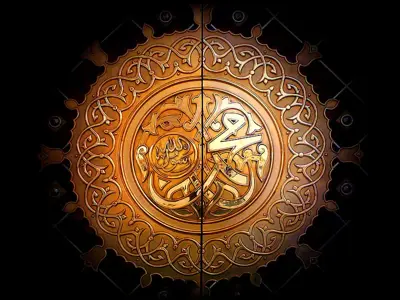
Muhammad was an Arab religious, social, and political leader and the founder of Islam. According to Islamic doctrine, he was a prophet, sent to preach and confirm the monotheistic teachings of Adam, Abraham, Moses, Jesus, and other prophets. He is believed to be the final prophet of God in all the main branches of Islam, though some modern denominations diverge from this belief. Muhammad united Arabia into a single Muslim polity, with the Quran as well as his teachings and practices forming the basis of Islamic religious belief.
