Muhammad Quotes
Embrace Islam, and you shall be safe. I am God’s messenger to all humanity, here to alert all those alive that non-believers are condemned. If you submit to Islam, you will remain kings, but if you abstain, your rule will be removed and my horses will enter your arena to prove my prophecy’
Oman was one of the first kingdoms to embrace Islam, albeit under the coercion described in this quotation.
Muhammad, 571-632, Prophet and Founder of Islam, Written Message to the Rulers of Oman, Al Aas to Jaiffar and Abd, sons of Al Julanda, ~630
Sourced by: Eigen's Political and Historical Quotations

This is actually a very widespread belief amongst many Muslims. Even sophisticated national leaders do not appreciate that other religions have adherents who feel just as passionately about their own religion. See {588668} for another example where Muslim leaders believe that if Jewish Kings David and Solomon came back to life they would worship Islam.


Essentially such a rigid conviction of unbelievers was common with both Protestants and Catholics in the middle of the second millennium, but Christian theology evolved and forgiveness and repentance became major factors. Islam did not so modernize so even in the 21st century a disbeliever deserved nothing from Muslims because Allah would never forgive them and they would be consigned to hell. So this Sura and {584363} made fundamentalist Muslim terrorists particularly willing to kill non-believers.


In the early stages of Islam, Muhammad had hoped to convert the Jews and others on the Arabian Peninsula. When they refused to be converted, he warred against them usually killing the men, and taking the women and children as slaves. The result was that non-believing tribes were “cleansed” from the Arabian Peninsula. The Muslims at the time preferred children as slaves. For then they could convert the children against their will. Adults in Islam must accept Islam in order to convert. Children are regarded as having no such maturity of decision making and therefore opposition to conversion may be ignored and they may be forced. Critics of Islam and those who argue that Islam is at odds with all other religions point to this quotation. They claim that it is the only religion whose founder and fundamental scriptures demand war against others for no other reason than that they believe in a different religion. The Catholic Church during the Crusades and the Inquisition had a similar philosophy as did Christian missionaries colonizing Africa later. One difference is that most Christians today repudiate the doctrine as against the true spirit and teachings of Christ and view it as historical error, while very few modern Muslims repudiate this quotation of the Prophet.
It is often said that Judaism, Christianity and Islam share the origin in Abraham. However, orthodox Muslims use this passage of the Koran to arguer that Abraham had nothing to do with Judaism or Christianity. The time line of Abraham—according to biblical time c. 4000 BC argues more for his Judaic origins, but Western religion has his sons splitting into the great faiths. Muhammed uttered these lines roughly 600 years after the birth of Christ.

Although this verse illustrates the particular enmity that some orthodox Muslims have for Christians and Jews, philosophically the hostility it not unlike that some orthodox Christians had (and still have) for Jews. The theory was that among the more primitive people a certain “ignorance” was tolerable, but “People of the Book” were not ignorant but actually rejected the word of Muhammed or in the case of the Jews vis a vis the Christians, they rejected the word of Christ. The hate message is preached within some Christian circles about Jews and Muslims today, but the overt, visible, statement in the midst of the holiest of Scripture makes the Koranic version even more socially and ethically difficult in a pluralistic society.
This statement by The Prophet has been interpreted by Muhammad Abduh and other Islamic modernists and reformers as a call for co-existence and common ground between Muslims on the one hand and Christians and Jews on the other. However, some Muslim extremists interpret this sura to mean that the call is for the Christians and Jews to accept Islam and THEN there will be common words. There is in modern times, there is no Islamic Hierarchy like a Pope to make a definitive determination about such an interpretation so Muslims are split on the interpretation. In that sense Muslims today are like Protestants, Jews and Buddhists.

This sura has justified major discrimination against non-Muslims so that they should never appear “preeminent” over the faithful. See for example, {617157} and {617160}.
This is often referred to as the “prophetic mission.” This line appears on most Muslim coins and some monuments.
While not in the Koran, this attributed statement is the basis for the ban on non-Muslims going on a Hajj and going to the most holy Muslim places—Mecca, Mina, Muzdalifa, and Arafat as well as the anti-religious hostility to all religions but Islam which is present in some Muslim countries.
See {586039} for a quotation that goes further and seeks to punish and humiliate the non believers. This sura is often used by those wishing to illustrate the intolerance of Islam—especially of other religions. They fail to put this into the context of the Old Testament which proscribed death for heretics or the history of Christianity regarding the murder of nonbelievers. The difference is however, that a very small proportion of Jews or Christians today believe in following Biblical instructions in this respect while the proportion of Muslims who believe in the literal interpretation of scripture on these points is much larger. However there are Islamic modernists and moderates throughout the world who reject this notion of warring on all other religions and there is a struggle going on within Islam itself.

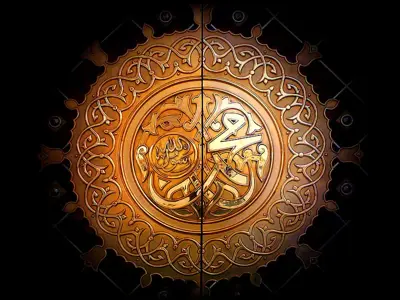
Muhammad was an Arab religious, social, and political leader and the founder of Islam. According to Islamic doctrine, he was a prophet, sent to preach and confirm the monotheistic teachings of Adam, Abraham, Moses, Jesus, and other prophets. He is believed to be the final prophet of God in all the main branches of Islam, though some modern denominations diverge from this belief. Muhammad united Arabia into a single Muslim polity, with the Quran as well as his teachings and practices forming the basis of Islamic religious belief.
