Martin Luther Quotes
The Pope should restrain himself and get his fingers out of the pie.
Martin Luther, 1483-1546, German Theologian & Founder of Protestantism, Quoted on PBS: Martin Luther, May 21, 2007
Sourced by: Eigen's Political and Historical Quotations

The King had earlier replaced the Pope as the head of the English church. The references to money referred to a then common corruption of the Church whereby people could buy indulgences—religious papal pardons of past or future sins. This was a major revenue source for the Vatican and a major issue for Martin Luther and the Protestant Reformers some of who saw the pope as the Devil incarnate See {623153}. For Martin Luther’s view pf the practice and {626720}, {595195}, and {639436} for other contemporary views.


Naples was an independent kingdom before the unification of Italy. This quotation illustrates one of the lowest periods of the Roman Catholic Church where the personal morality of the Pope and Cardinals was greatly at odds with the earlier and current positions of the Church. This hypocrisy, nepotism, and corruption was one of the major factors that led to the Reformation. Note that the Pope had an illegitimate son who he named a Cardinal and the Pope wanted his son to marry the daughter of the king. The king was not enthusiastic given the son’s status as a Cardinal of the Church.

Much of the Catholic Church was greatly influenced by Aquinas long past his death. This quotation laid the foundation for the view, that anything the Church does, even if seemingly wrong or absurd, has some positive value. Here, Aquinas refused to totally condemn the Church practice of giving indulgences (official absolution for serious sins) to the rich in exchange for money. His view assumes that there must be some good in all acts of the church, even if we can not now determine it. This view makes reform very difficult even after the evil is recognized. Some theologians argue that although this perpetuates some bad practices, it provides stability and prevents leaders of the church from constantly trying to adapt the church to meet current popular or civil criticism.


Wycliffe, although a Roman Catholic, was an early reformist. He not only opposed the Pope vis a vis King Edward of England, but he went against church doctrine and printed the first English Bible. He was burned at the stake.


The Holy Roman Emperor and the Pope were at odds. The Pope had issued an edict staking out the powers of the Pope. King Henry called a conclave of clerics and deposed Pope Leo VII. The Pope Excommunicated Henry and deposed him as king and emperor. Civil war ensued, and finally they reached a compromise and accommodation with each other." Saint Hildebrand
This began the Church's most notorious attack on any dissent or disagreement and it was the start of the Inquisition.

This detestable accusation completely ignores the fact that when the American Catholic Church had a raft of homosexual priests in the early 21st century, the Pope condemned this in the most uncertain terms. Child homosexual molestation is vehemently condemned by both Catholicism and Islam alike—also by straights and homosexual groups.


Lotario de' Conti


Smith was the first Roman Catholic to run for President. He was very popular but there was a substantial amount of anti-Catholicism in America at the time. He lost, probably by the margin of the anti-Catholic vote.

Karol Jozef Wojtyla. Many critics thought the Pope to be ignorant and repressed about sexuality given his prohibition of birth control. However, as this quotation amply, demonstrates, Paul II understood much more about sex than most and was active in dealing with such things as sensuality and female desire.

Many of the Church wanted Wycliff excommunicated, but the King and Parliament seemed to like his writing and sermons. So he was protected in his lifetime. He died at the age of 60 of a stroke. After his death the Church burned all his books that had been banned, and exhumed his body. That was burned at the stake and his ashes scattered in a river. Martin Luther did not try to reform the Church in a vacuum. There had been various critics of the Church before Luther and Wycliff was one. The last statement in this quotation was the one that really hit the then mostly corrupt clergy where it hurt.
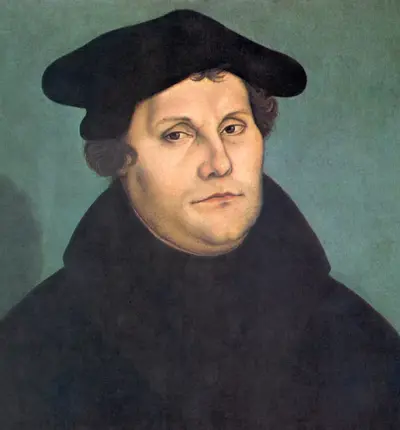
- Born: November 10, 1483
- Died: February 18, 1546
- Nationality: German
- Profession: Friar, Priest, Theologian, Professor
Martin Luther, O.S.A. was a German professor of theology, priest, author, composer, Augustinian monk, and a seminal figure in the Reformation. Luther was ordained to the priesthood in 1507. He came to reject several teachings and practices of the Roman Catholic Church; in particular, he disputed the view on indulgences. Luther proposed an academic discussion of the practice and efficacy of indulgences in his Ninety-five Theses of 1517. His refusal to renounce all of his writings at the demand of Pope Leo X in 1520 and the Holy Roman Emperor Charles V at the Diet of Worms in 1521 resulted in his excommunication by the pope and condemnation as an outlaw by the Holy Roman Emperor.
