Los Angeles Times Quotes
The phenomenon of Harry Hopkins must never again be allowed to occur.
Harry Hopkins was the special assistant to President Franklin Delano Roosevelt through the two great American crises, the Great Depression and World War II. Although he was a social worker with not a shred of political experience, Hopkins was originally selected by the President to operate the national relief program in the midst of the Great Depression. Soon he had spent more money than any human being in history without a taint of scandal. He had never been elected nor was he even ratified by the Senate. He also paid virtually no attention to members of Congress as he became the most successful manager in American Government history. Soon he became FDR’s most important aid. Then he and his wife actually moved into the White House and lived there with the Roosevelts and was a favorite of not only FDR but Eleanor Roosevelt as well. When WWII began the leading military and diplomatic leaders advised the President not to provide military aid to England or Russia believing that these countries could not hold out and the weapons would fall into German hands and be used against American soldiers. Roosevelt sent Hopkins to Europe to assess the military situation despite the fact that he had never had a single day of military experience. When his war advice contradicted that of the leading generals and admirals, many people were scandalized, especially when FDR took Hopkin’s advice above that of the generals and diplomats. Massive assistance was sent to those countries and indeed both were able to hold out just as Hopkins had predicted. No one in American politics before or since had that much influence or power. Most historians see that particular phenomenon as a unique combination of two extraordinary men at an extraordinary time and virtually impossible to replicate.
Los Angeles Times, Editorial, Quoted in TV Documentary, Harry Hopkins: At FDR’s Side, 1989
Sourced by: Eigen's Political and Historical Quotations


Lincoln was not above personal attacks on the opposition:

He addressed the Prince in the Royal 3rd person “the Prince” instead of saying “You”, the 2nd more familiar person. “Stadtholder” meant Chief Executive and Ruler. Bentinck was the Stadtholder of a Province. Prince William was Stadtholder of all of Holland. Bentinck was one of the few politicians who could and would be so candid with the Stadtholder whose cronies and friends were aristocrats who had much damaged the state and were very unpopular. William did not act and died shortly thereafter. The House of Orange and the Orangists, despite strong English support, were turned out in the Dutch Revolution.


She and her husband had been flown across the country for a campaign fundraiser by a private businessman in his corporate jet. Republican Speaker of the House Dennis Hastert was also on the flight. Her husband was censured for an ethical violation but Hastert was not.

When he became president himself, he not only served 10 years but changed the constitution so that he could serve forever and was still President over 20 years later. See {620732} for another similar statement.


No one had a majority of the Electoral College and the election was thrown into the House of Representatives. Henry Clay was the Speaker of the House, and had a grudge against Jackson. He convinced several of the State congressional delegations to vote for John Quincy Adams, and when Adams was President, he made Clay the Secretary of State, then the most powerful cabinet position. Hence Jackson’s characterization.
The early history of Utah was very complicated. At this time Utah had become a territory of the United States and as a compromise with the Mormons, Brigham Young was appointed Territorial Governor. However, Young was used to ruling unilaterally as the head of a church, not government in a democratic society where he was responsible for the laws of Congress and the Executive Orders of the President.

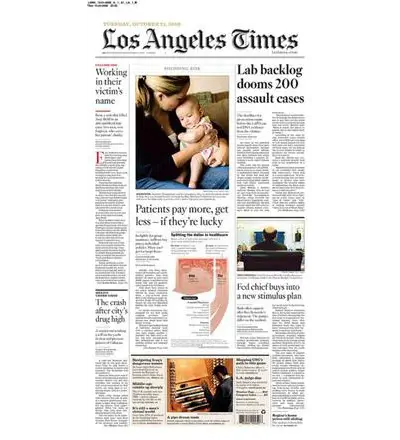
The Los Angeles Times (sometimes abbreviated as LA Times) is a daily newspaper based in El Segundo, California, which has been published in Los Angeles, California, since 1881. It has the fifth-largest circulation in the U.S., and is the largest American newspaper not headquartered on the East Coast. The paper focuses its coverage of issues particularly salient to the West Coast, such as immigration trends and natural disasters. It has won more than 40 Pulitzer Prizes for its coverage of these and other issues. As of June 18, 2018, ownership of the paper is controlled by Patrick Soon-Shiong, and the executive editor is Norman Pearlstine.
