James II Quotes
The nobles will stand by the crown and the crown must stand by them … except the Campbells.
James II, 1633-1701, King of England and Ireland (James VII of Scotland), Instructions to the Earl of Perth regarding whom he had appointed Governor of his son and heir, James III (James VIII of Scotland,) July 19, 1696
Sourced by: Eigen's Political and Historical Quotations


All members of Parliament were required to sign and publicly declare this oath. Two days later the Parliament ordered the oath—then called a “protestation”—printed and distributed throughout the realm. All minor officials and clerics were also required to make their “protestation.” It was excesses like this that created a negative attitude in England regarding loyalty oaths and the American Founding Fathers specifically knew of this—then relatively recent—example when they wrote the Constitution and the Bill of Rights. We have left the then English spelling as is.


This is one of the best examples of the Mongol Terror Tactics. They had a completely mobile fighting force. They could evade any large army and attack fixed towns and villages, while opponents could not defend all the locations without enormous expense. The calculus was often that it was cheaper to pay the Mongols tribute than it was to even beat them in the field. In this case, the Hungarians settled and a Mongol satellite group—the Cumans (Western Kipchaks)—moved into Hungary and have been a minority there ever since.

Arnold was not just any senior officer, but one who had been a great fighter against the British not only, leading his men brilliantly but exposed himself to great danger in the process. He had been such a hero that Washington could not imagine how an officer like that could become a traitor to the cause. Arnold’s treasom had nothing to do with ideology or the issues of the war. Arnold felt that he had not been appreciated for his efforts (his commanding officer gave him no credit for the most heroic and effective military battlefield leadership up to that point in the war) and became disaffected.


The revolutionary acts from some of the more radical colonists but the colonial power structure was trying to negotiate for changes from the taxation and rights-impinging laws that Parliament had passed. Within a year the Continental Congress would take a more revolutionary position when this petition yielded no betterment-- {636864} and {636958}.


Strong argued in petitioning a Connecticut court for divorce in 1788 that her husband’s abuse had removed her obligation to obey him


In the British Constitutional Monarchy of the Victorian Era, the Queen still possessed enormous power and many in Parliament was constantly trying to have Parliament assume many of the Queen’s powers. The Prime Minister was in an awkward position. On the one hand, he was the Queen’s Prime Minister and leader of HER government. At the same time he was the leader of the political party that had won the last Parliamentary election. His party was trying to usurp some of the Queen’s powers and Peel explained to the Queen’s assistant that he would generally side with the Queen against his own party. It is doubtful that Anson and the Queen believed Peel on this point as his position as Prime Minister depended not on his being elected by the voters but by his party members of Parliament. In modern times, the British monarch has few real powers but is still very influential so there are no struggles over power with Parliament.


Although Queen Victoria was modern and liberal in many respects, the idea of self-determination by majority vote was unthinkable and certainly undesirable for her. She was not opposed to lands and peoples changing empires and peoples per se. It was how the decision was made that was critical to her. Sovereigns had been buying, selling, and trading lands and peoples for centuries. And after wars, the winners would also reallocate the kingdoms of the loser. But the idea of a democratic plebiscite making the decision was unacceptable. To her and many others of the day, power struggles between factions, politicians, and sovereigns themselves would cause them to inflame the passions of the people and/or bribe the people to vote to change their allegiance. She saw popular but possibly unscrupulous politicians “blackmailing” kings and queens and if payments from the treasury would not be made, the politician would stir up a movement to transfer allegiance to another sovereign who might well be willing to pay.

There was a legal requirement that all cadidates for the parliament had to sign before the election an oath swearing to take their seat if elected to close off the possibility that some would cripple the parliament by winning but not taking their seats. De Valera wanted to run, and fully intended to take his seat, but had promised to sign no oaths about the parliament elections. On the last day possible, he went to the election clerk who gave him a piece of paper with the oath printed on the top and below it, the lines for candidate signatures. De Valera took a blank piece of paper and covered the oath but leaving the signature line exposed. He then signed the line and made sure that the clerk would remember that he has not signed an oath, but had signed a blank piece of paper where the oath could not be seen. To him this was a very important distinction but if failed to convince most other Irishmen.
The Emperor had made his brother King of Holland, thinking of it as an unimportant backwater of the French Empire. But Louis took his oath and job very seriously, and although he did not have the great talent of his brother, he made a serious effort to be a good king.

This was his name for the wealthy slaveowners in Tennessee. He was the military governor of Tennessee when he so labeled the secessionists.

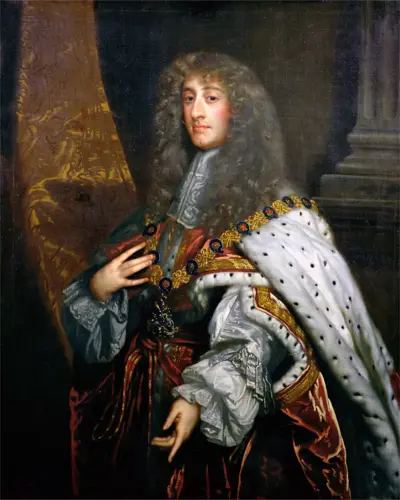
James II and VII was King of England and Ireland as James II, and King of Scotland as James VII, from 6 February 1685 until he was deposed in the Glorious Revolution of 1688. He was the last Catholic monarch of England, Scotland, and Ireland; his reign is now remembered primarily for struggles over religious tolerance. However, it also involved the principles of absolutism and divine right of kings, and his deposition ended a century of political and civil strife by confirming the primacy of Parliament over the Crown.
