Mao Zedong Quotes
The main targets of attack by the peasants are the local tyrants, the evil gentry and the lawless landlords, but in passing they also hit out against patriarchal ideas and institutions, against the corrupt officials in the cities and against bad practices and customs in the rural areas. In force and momentum the attack is tempestuous; those who bow before it survive and those who resist perish. As a result, the privileges which the feudal landlords enjoyed for thousands of years are being shattered to pieces. Every bit of the dignity and prestige built up by the landlords is being swept into the dust.
In 1927 there was a Peasant Uprising in the Hunan Province of China. Young Mau went there and wrote a report.
Mao Tse-Tung, 1893-1976, Chairman, Communist Party, China, Report On An Investigation Of The Peasant Movement In Hunan, 1927
Sourced by: Eigen's Political and Historical Quotations

There had been a Chinese Revolution in 1911, but although there were changes at the seat of government and in urban areas, the rural areas where most of the people lived changed little if at all. The revolution failed as a result of it became a revolution without reform.
Those landlords who had killed peasants were sometimes executed as prior to the Peasant Uprising, there was no law enforcement against landlords in rural areas like Hunan. In 1927 there was a Peasant Uprising in the Hunan Province of China. Young Mau went there and wrote a report. Many years later when Mao was a major revolutionary leader, the landlords were often executed and not just humiliated.


And as the leader of the exploited, after his revolution he became a dictator himself, albeit a very popular one amongst most Cubans.

In 1927 there was a Peasant Uprising in the Hunan Province of China. Young Mau went there and wrote a report. Mao and other young communist leaders had a much more acute appreciation of sloganeering than their older revolutionary comrades. Even into the 3rd millennium, the same “Down with Imperialism” slogan could be heard in many part of the world, long after the Soviet Union collapsed and China and become capitalistic.
In 1927 there was a Peasant Uprising in the Hunan Province of China. Young Mau went there and wrote a report. Corruption has plagued China for millennia. As can be seen by this quotation, Mao thought that a “people’s revolution” would end corruption and despite capital punishment for corruption under the Communist government, corruption still thrived. By the 21st century corruption was common among local Communist Party Officials despite national party and government attempts to obliterate it.

Zenzinov was often a critic of the Bolsheviks.
The occasion for the speech was the 60th birthday of Russian Premier, Joseph Stalin.


Vladimir Lenin. Most did not and the Communist government was brutal and murderous in forcing them into the Communist culture, outlook, and behavior. See {640096} for a description of some of the effort.

Louis Napoleon had seized control of France and had very little popular support amongst the aristocracy and middle class. However, the Socialists leading the uprisings frightened them more than Louis Napoleon as the Socialists had the support of the peasants who resented the abuses of the aristocracy and many of the middle class. This was true class warfare and not at all what was possible in the United States when American conservatives would claim “class warfare” when there was a move for more progressive taxation. In Europe, class warfare really meant death and destruction, so for many who knew the history, the claim of “class warfare” was frightening and a large part of the “Red Scare” in the United States.


Lev Davidovich Bronstein


This is a very important historical, political quotation. The conservatives have since the Russian Revolution conflated socialism and communism. However, here in 1932 the leader of the American Socialist Party had already described the Communist Revolution in Russia as a failure of founding an acceptable modern state. Nonetheless, even into the 21st century many conservatives describe Thomas as a Communist. See {626692} for his distinction between Communism and Socialism. The difficulty of modern nation building was explained by Thomas and others but was really not accepted until the many attempts of the early 21st century, some supported by America like Iraq and Afghanistan and the Balkans and others like the “Arab Spring.” Then his early wisdom on this point became more appreciated.

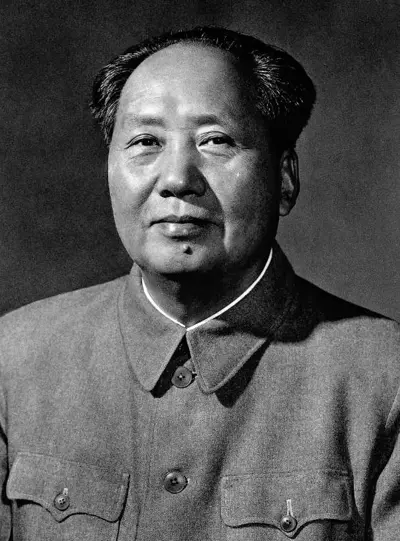
Mao Zedong, also known as Chairman Mao, was a Chinese communist revolutionary who was the founder of the People's Republic of China (PRC), which he ruled as the chairman of the Chinese Communist Party from its establishment in 1949 until his death in 1976. Ideologically a Marxist–Leninist, his theories, military strategies, and political policies are collectively known as Maoism.
