Dwight D. Eisenhower Quotes
The financial solvency and economic soundness of the United States constitute the first requisite of collective security in the free world. That comes before everything else.
This was a fundamental principle of the Republican party in the middle of the 20th century. However, by the end of that century, Republican doctrine, with the support of the Military-Industrial Complex {641114}, had changed to place defense spending as the highest priority—so much so that the huge deficits created by the massive defense spending weakened the financial solvency that Eisenhower had warned that was more fundamental.
Dwight D. Eisenhower, 1890-1969, 34th President of the United States (Republican, KS), 1953
Sourced by: Eigen's Political and Historical Quotations

This was the origin of the term "military-industrial complex." This speech was written by Malcolm Moos who first penned the term. However, conceptually it was referred to earlier by C. Wright Mills in 1954— {623497}.


_0_thumbnail_47x47.jpg "Bill White, Mayor of Houston, Texas")

The most successful way of poor nations developing rapidly is to trade with rich nations.


Prince de Benévant. Alexander Hamilton had devised a system of bonds to assume the revolutionary war debt, and, despite the objection of many other politicians like Jefferson, assumed a national debt. But the Untied States was growing and Hamilton’s bonds were so well implemented, that even the sophisticated leaders of Europe were openly admitting that U. S. Bonds were excellent investments and Europeans and other foreigners have been buying American debt ever since.


Kennedy, with great Republican support proposed a reduction of the top income tax rate from 91% to 65%, reduction of the bottom rate from 20% to 14%, and a reduction in the corporate tax rate from 52% to 47%. That put the tax rates at the appropriate level. Economic growth was reasonable until President Reagan’s military spending cold war strategy produced huge deficits, Clinton raised the tax rates slightly and had the best economic growth ever, and had a balanced budget. George W. Bush lowered taxes had much slower growth and even larger deficits. However, by 2013 all hints of bipartisanship were gone. The Republicans claimed that the then tax rates were much too high—the highest income tax was half the rate that most agreed in 1962 was the right rate. And the corporate tax was 35 %, far lower than the Kennedy rate of 47% and incredibly lower when we consider that with deductions that were then in force the average corporate tax was only 12% the lowest since the Great Depression. Meanwhile the 2008 Bush Economic Meltdown and the Great Recession it produced the highest deficits in history with the lowest taxes in modern times and much of the polarized population demanding further tax cuts and an equal number demanding increased tax revenue.


The big priorities will focus on the security and economic side because they really go hand in hand.
This quotation Illustrates a conflation of American national security and economics.


The Progressive article was an interview with Movie Director and Screenwriter Oliver Stone who told the interviewer that he had learned of this quotation when he did his research for his film, South of the Border where he had several interviews with President Kirchner.
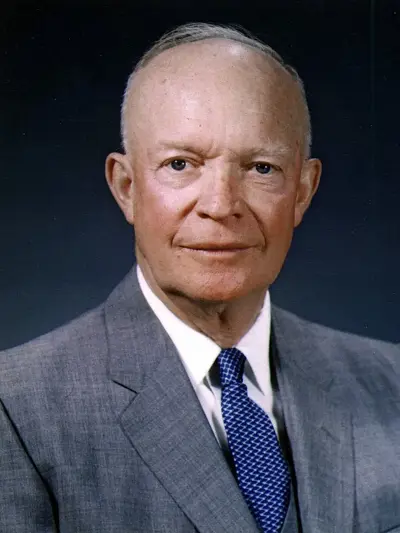
- Born: October 14, 1890
- Died: March 28, 1969
- Nationality: American
- Profession: President
Dwight David "Ike" Eisenhower GCB OM GCS CCLH KC NPk was an American military officer and statesman who served as the 34th president of the United States from 1953 to 1961. During World War II, he became a five-star general in the Army and served as Supreme Commander of the Allied Expeditionary Force in Europe. He was responsible for planning and supervising the invasion of North Africa in Operation Torch in 1942–43 and the successful invasion of Normandy in 1944–45 from the Western Front.
