John Quincy Adams Quotes
The establishment of a naval academy, furnishing the means of theoretic instruction to the youths who devote their lives to the service of their country upon the ocean, still solicits the sanction of the Legislature. Practical seamanship and the art of navigation may be acquired on the cruises of the squadrons which from time to time are dispatched to distant seas, but a competent knowledge even of the art of ship building, the higher mathematics, and astronomy; the literature which can place our officers on a level of polished education with the officers of other maritime nations; the knowledge of the laws, municipal and national, which in their intercourse with foreign states and their governments are continually called into operation, and, above all, that acquaintance with the principles of honor and justice, with the higher obligations of morals and of general laws, human and divine, which constitutes the great distinction between the warrior-patriot and the licensed robber and pirate -- these can be systematically taught and eminently acquired only in a permanent school, stationed upon the shore and provided with the teachers, the instruments, and the books conversant with and adapted to the communication of the principles of these respective sciences to the youthful and inquiring mind
This historical quotation is the “pitch” President Adams made to the Congress to establish the U. S. Naval Academy. It would be 18 more years before the Academy opened. Congress was not very rapid in its decision making even then.
John Quincy Adams1767-1848, 6th President of the United States (Independent, MA), State of the Union Address, Washington, DC, December 4, 1827
Sourced by: Eigen's Political and Historical Quotations


Raiders operating out of the Barbary Coast typically would attack any American shipping seizing the goods and the ship and ransoming the crew or passengers or selling them as slaves. English and French governments had paid the Tripoli tribute for safe passage. The President and Congress sent American ships to in effect blockade the corsairs in their harbors.

It was this directive, together with the evidence of its acceptance by the Japanese soldier fighting to the death in Saipan and Okinawa, that lead President Truman and Chief of Staff Marshall to conclude that more lives would be saved by using the atomic bomb than invading the Japanese mainland. See {641063}


America’s oldest foreign policy problem has been freedom of the seas for American shipping. Since the end of WWII, the U. S. however performed this function—and pays for it—for the entire world with some minor exceptions.


This quotation is a wonderful illustration of the change that has taken place in the American military. The young man who was not skilled enough for anything else was meant to be a soldier. By 2010 only one in four high school graduates would be skilled and intelligent to be qualified for the Untied States Navy. The other services also had high requirements in order to function with the high technology, of the modern military.


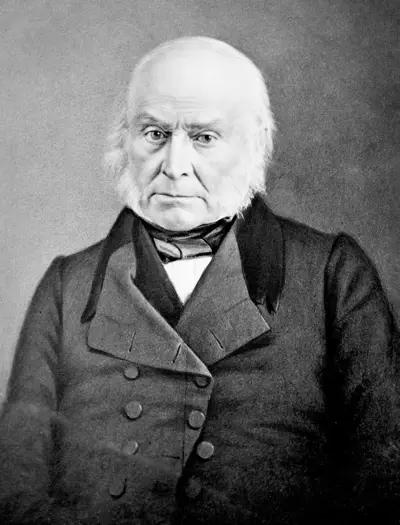
John Quincy Adams was an American statesman, diplomat, lawyer, and diarist who served as the sixth president of the United States, from 1825 to 1829. He previously served as the eighth United States Secretary of State from 1817 to 1825. During his long diplomatic and political career, Adams also served as an ambassador, and as a member of the United States Senate and House of Representatives representing Massachusetts. He was the eldest son of John Adams, who served as the second U.S. president from 1797 to 1801, and First Lady Abigail Adams. Initially a Federalist like his father, he won election to the presidency as a member of the Democratic-Republican Party, and in the mid-1830s became affiliated with the Whig Party.
