DeWitt Clinton Quotes
The enhancement of the profits of agriculture, the excitement of manufacturing industry, the activity of internal trade, the benefits of lucrative traffic; the interchange of valuable commodities – the commerce of fertile, remote, and wide-spread regions, and the approximation of the most distant parts of the Union, by the facility and rapidity of communication that will result from the completion of these stupendous works, will spread the blessings of plenty and opulence to an immeasurable extent. The resources of the State are fully adequate without extraneous aid; and when we consider that every portion of the nation will feel the animating spirit and vivifying influences of these great works; that they will receive the benediction of posterity and command the approbation of the civilized world; we are required to persevere by every dictate of interest, by every sentiment of honor, by every injunction of patriotism, and by every consideration which ought to influence the councils and govern the conduct of a free, high-minded, enlightened, and magnanimous people.
This section of the message was all about the Erie Canal that was under construction. Note that unlike today, where interest in public works and development is so localized, Clinton was extolling the virtue of developing the economy of the region and the nation. The money was all New York State money. The Federal Government would not fund the Erie Canal as they did not believe it was technically feasible to construct. See {624484} . Patriotism had a different meaning then.
DeWitt Clinton, 1769-1828, Vice President of the United States (NY), U. S. Senator (Anti-Federalist Republican, NY), Mayor of New York City, Governor of New York, Peace Party candidate for President of the United States, “Father of Free Public Schools", First Address as Governor to the Legislature, January 28, 1818
Sourced by: Eigen's Political and Historical Quotations

It (the proposal to build the Erie Canal) is a splendid project and may be executed a century hence.
Jefferson was usually far in advance of most men in his understanding of science and technology. However, he missed the boat literally and figuratively on this project. He did not think that the technology and engineering of the day were sufficient to complete such a huge a complicated project. His experience in the South was that large projects would require large numbers of slaves who had to do highly technical work that was also very challenging physically. The great problem was that the New York area was filled with huge, deep rooted trees. The canal would have to wind around the giant trees and still be navigable. This was a case where Jefferson’s Southern insularity hampered him. He did not count on two things: First was the engineering technology of New York where there were very few slaves and labor saving technology was valued and well developed. New York engineers had huge horse powered machines that could remove the stumps of the largest trees in less than an hour. The Erie Canal would not go around the large trees but straight through the forest shortening the canal digging substantially. Second, he did not realize what free Irish labor was capable of in terms of productivity and mixing brain and brawn. Although he rejected the idea, De Witt Clinton convinced the NY State legislature of the feasibility and the legislature appropriated the then enormous sum of $7 million. The Erie Canal was the most important development project in the nation until the railroad. New York became the richest and largest state as a result and New York City went from a medium sized city to the largest city and the largest port in the country.


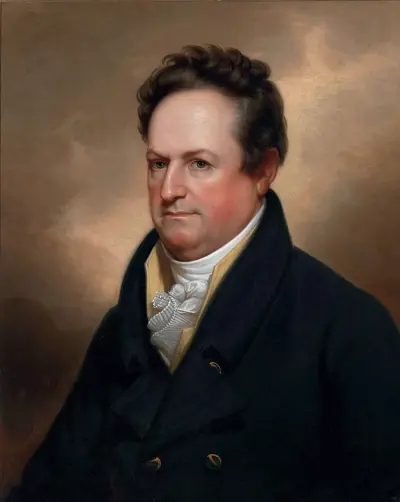
DeWitt Clinton, whose name was almost always spelled De Witt during his lifetime and until the late 20th century, was an American politician and naturalist. He served as a United States Senator, Mayor of New York City, and as the sixth Governor of New York. In this last capacity, he was largely responsible for the construction of the Erie Canal. Clinton was a major candidate for the American presidency in the election of 1812, challenging incumbent James Madison.
