Joseph Conrad Quotes
The conquest of the earth, which mostly means the taking it away from those who have a different complexion or slightly flatter noses than ourselves, is not a pretty thing when you look into it too much.
Conrad, Joseph. Youth: A Narrative, and Two Other Stories. William Blackwood and Sons, 1902, p. 58.


The highway was planned to go through a poor neighborhood which had a high percentage of Black residents—all of whom would have to find other housing and move to make room for the highway. If the government plans a highway through a wealthy area, the cost to condemn and pay for the land will be much greater than if a poor neighborhood is acquired. For urban highways, the poor almost always bear a disproportionate share of the inconvenience while the major benefit inures to the wealthy and middle class. Abbot had been a labor organizer and a professional artist before he entered politics. The graphic is of his famous poster which by itself stopped the plans to build the highway very quickly.

The question has always been of adherents of this viewpoint, “How do we decide which side is the more civilized. The Nazi Germans thought they were the most civilized people in the world and killed more than 22 million people demonstrating their civilization which most others looked upon as savagery.


Mather was urging the community to protect their children against the Devil and his band. To exemplify just how terrible Devils were to his audience, he used a comparison to the worst thing the audience was familiar with—Indians. Although there were a few examples in Colonial America of Indians being perceived as benign or even people, they were few and far between, and tended to be in New York and Pennsylvania.

While he fairly described the Spanish intentions, the reality which was not known at the time, was that most of the deaths in South America were caused by disease brought by the Spanish for which Europeans had some immunities and the natives of the New Word, none.

This quotation distressed many ultra rightists who otherwise were avid followers of Mises. See {632407} for another quotation that distressed many European conservative devotees of Mises.


At the time, some Palestinian Arabs claimed exclusive rights to the territory on the grounds that Arabs had dominated the area for the longest period of time. They gave no credence to the fact that the Jews had dominated the area and it was the center of their kingdom for many years before—that Jews had constantly lived in the area of longer than the Arabs, nor did they give any credence to the fact that the Christians had conquered the area from the Muslims during the Crusades.

This statement was made long after slavery had been abolished and Jim Crow was on the rise in the South.


He reversed the Spanish policy of keeping guns from the American Indians. He provided arms with the express intention that they destroy each other. This policy almost worked for the Indians of California but several Indian tribes were exterminated.


The Newspaper acknowledged that the conquest of Mexico was tantamount to a rape, but the editors were convinced that the Mexicans would be very happy once they were in the American orbit. In almost every case in American history where we invaded and occupied a country, the political leadership, most of Congress, and many American citizens were convinced that American freedom and democracy were so much better than any other form of government that the conquered people would not only welcome the Americans but would voluntarily reorganize their governmental structures to have a democracy. While there were always some people in each country who did feel that way, the majority rarely did, much to American surprise.


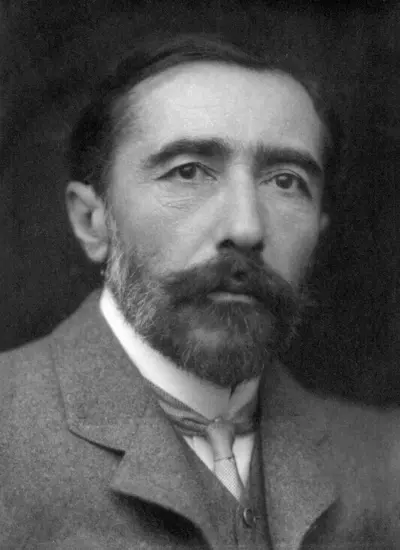
Joseph Conrad was a Polish-British writer regarded as one of the greatest novelists to write in the English language. Though he did not speak English fluently until his twenties, he became a master prose stylist who brought a non-English sensibility into English literature. Conrad wrote stories and novels, many with a nautical setting, that depict trials of the human spirit in the midst of what he saw as an impassive, inscrutable universe.
