Calvin Coolidge Quotes
The chief business of the American people is business.
Sometimes this is misquoted as 'The business of America is business.' See Woodrow Wilson for an earlier statement of this idea which is almost always incorrectly attributed to Coolidge as the originator of the idea.
Calvin Coolidge, 1872-1933, 30th President of the United States (Republican, MA), Speech, American Society of Newspaper Editors, Washington DC, January 17, 1923,
Sourced by: Eigen's Political and Historical Quotations

Coolidge was extremely pro business. See {598686}.


While generally true, Mises here again exaggerates his “proof” by selectively ignoring or being ignorant of counter-examples. The Roman Catholic Church is a classic counter-example where priests, monks, and others owned nothing as individuals, but produced some great science (eg Gregor Mendel), art (the illuminated texts of the middle ages), literature (St Thomas Aquinas, etc). The best counter example that was just evident in the last decade of Misis’ life is Communist Russia. Russian science was better than Fance and Germany and second only to the United States. The Russian ballet and orchestras were second to none. Great literature came out of the Soviet Union and the best of it complained about and attacked the Soviet system of the times. In general, Mises principle tended to be correct throughout history but not always as he dogmatically stated.


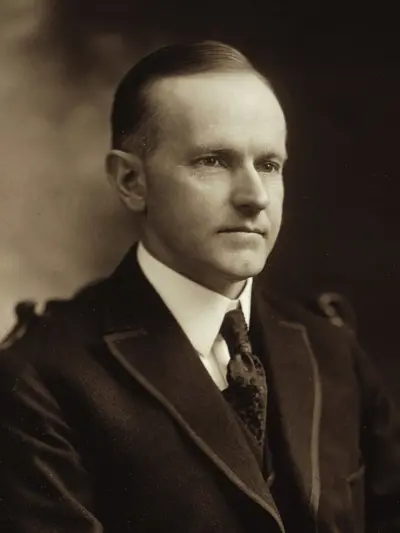
- Born: July 4, 1872
- Died: January 5, 1933
- Nationality: American
- Profession: President
Calvin Coolidge was an American lawyer and politician who served as the 30th president of the United States from 1923 to 1929. A Republican lawyer from New England, born in Vermont, Coolidge worked his way up the ladder of Massachusetts state politics, eventually becoming governor of Massachusetts. His response to the Boston Police Strike of 1919 thrust him into the national spotlight and gave him a reputation as a man of decisive action. The next year, he was elected the 29th vice president of the United States, and he succeeded to the presidency upon the sudden death of Warren G. Harding in 1923. Elected in his own right in 1924, he gained a reputation as a small-government conservative and also as a man who said very little and had a rather dry sense of humor.
