Mahatma Gandhi Quotes
The Charkha in the hands of a poor widow brings a paltry price to her, in the hands of Jawaharlal; it is an instrument of India's freedom.
Gandhi, Mahatma. The Collected Works of Mahatma Gandhi. Publications Division, Ministry of Information and Broadcasting, Government of India, 1958-1994.


This is another example of how President Roosevelt conducted his own international diplomacy independent of his own State Department. At the time, the U. S. State Department would not have any contact with Nehru who was in and out of British Indian jails for his anti-Colonial agitating. Roosevelt, however was a great admirer of Nehru and the Congress party and the commitment to democracy, freedom of religion, speech and the press and civil rights. Roosevelt and the American military strategic leaders were beginning to worry that China, even with help, would not be able to hold off the Japanese aggression, and India would become a frontier for the Allied war effort. The President realized that Nehru and his Congress Party were pressuring England for independence and extreme Indian nationalists were advocating non-support of the British military effort and strikes and protests to bog down the British army dealing with them instead of fighting the Japanese in Burma and elsewhere. There were a large number of Indian Brigades fighting for the British and if the Indian military volunteers were to be discouraged or boycotted, the allied war effort would suffer. So the President's style was to personally see what he could contribute over and above (and often to the distress of) his agencies established to do the job.


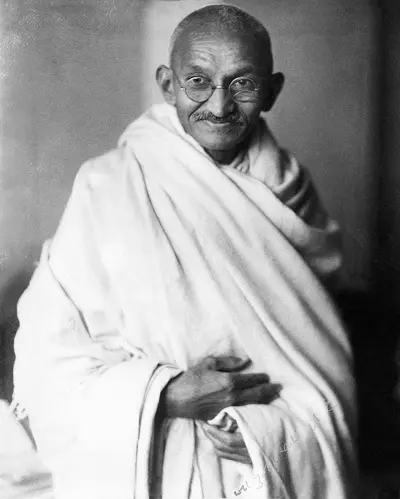
Mohandas Karamchand Gandhi was an Indian lawyer, anti-colonial nationalist, and political ethicist, who employed nonviolent resistance to lead the successful campaign for India's independence from British rule, and in turn inspired movements for civil rights and freedom across the world. The honorific Mahātmā (Sanskrit: "great-souled", "venerable"), first applied to him in 1914 in South Africa, is now used throughout the world.
