Kalakaua Quotes
The Bayonet Constitution
Kalakaua, [David Kalakaua], Last King of Hawaii, Name he gave the constitution he has forced to sign—literally at the point of a bayonet
Sourced by: Eigen's Political and Historical Quotations

The issues of check and balances in the American constitution were radical by world standards of the day. However, it was by no means an new concept and as this quotation illustrates was discussed and debated in England, but although England was far ahead of almost all other countries with respect to eliminating absolute power, they never took it as far as the Americans did. That took a revolution.

Senator Grimes thought that Andrew Johnson was a terrible President, but when the House of Representatives impeached President Johnson and he was tried before the Senate, Grimes voted for acquittal. His reason for the his vote was he thought that the Constitution did not provide for the removal if a President just because he has “Unacceptable.” Johnson survived removal from office by a single vote and had Grimes not been so principled about the Constitution, Johnson would have been removed from office. On the other hand, Johnson was a terrible President and many of the nations racial problems in later years emanated from his actions and inactions while in office.


The message was actually a threat in effect telling Parliament that if it did not pass the correct appropriations, the king might supplant them. He dissolved Parliament later that year. Note that the partisanship of the times was principally between the king and the parliament.


Cromwell was not opposed to monarchy per se as long as it was reasonably checked. He saw Charles II as a terrible monarch. After deposing Charles, he and his associates had to come up with some form of government. As “Lord Protector” he was a de facto monarch without the trappings.

This president served his terms as allowed by the Constitution but then moved to change the constitution so that he could be the dictator as perpetual president. The purpose of constitutions is to limit and control the day to day political process and processes of reform. This stands the purpose of a constitution on its head. Modern totalitarian states almost all have constitutions. However where they differ from democracies is that the dictatorships ignore their constitutions, constantly suspend them in “emergencies” or change them at will to serve the interests of the ruling authorities. See {622125} for a Supreme Court Justice’s view of this kind of situation.


Lotario de' Conti. The Pope did not want anything to diminish the absolute power of Kings as Popes might be next to lose their absolute authority. Despite the Pope’s nullification, Magna Carta had huge influence in England and the world. Note that the Pope actually called the agreement “unjust”, which gives us an excellent idea of the concept of justice amongst the power elites of the 13th century.

Some of the Patriots of Early America realized that the oppressions of British rule were coming from Parliament and initially took the position that only the King could make laws for the colonies and not Parliament. Therefore, they were as Englishmen challenging illegal English laws. Most American hostility was directed at Parliament and not the King. However, once there was any physical resistance, King George came down with such a heavy hand that American hatred transferred to him. For related quotes on the King/Parliament issue, see {639145}, {639143}, {639142}, {639141}, {639140}, & {639137}

The revolutionary acts from some of the more radical colonists but the colonial power structure was trying to negotiate for changes from the taxation and rights-impinging laws that Parliament had passed. Within a year the Continental Congress would take a more revolutionary position when this petition yielded no betterment-- {636864} and {636958}.


The committee to draft the Dutch Constitution had met and agreed on a basis for the constitution they would write. However, they decided to run the basis past the General Assembly before they started drafting specific language. There was much enthusiasm for their basis although there were a number of more conservative delegates who would rather have seen the Orangist monarchy brought back. It is easy to see how the United States Constitution and Bill of Rights influenced the Dutch drafters even though the American Constitution was only 11 years old.
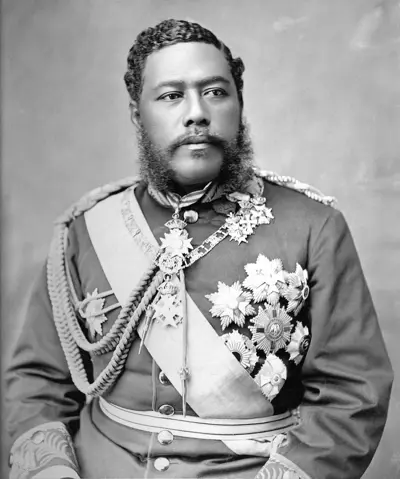
Kalākaua, sometimes called The Merrie Monarch, was the last king and penultimate monarch of the Kingdom of Hawaiʻi, reigning from February 12, 1874, until his death. Succeeding Lunalilo, he was elected to the vacant throne of Hawaiʻi against Queen Emma. Kalākaua had a convivial personality and enjoyed entertaining guests with his singing and ukulele playing. At his coronation and his birthday jubilee, the hula that had been banned from public in the kingdom became a celebration of Hawaiian culture.
