Innocent III Quotes
By violence and fear he [King John] was forced to accept an agreement which is not only shameful and degrading but illegal and unjust … That charter we declare null and void forever
Lotario de' Conti. The Pope did not want anything to diminish the absolute power of Kings as Popes might be next to lose their absolute authority. Despite the Pope’s nullification, Magna Carta had huge influence in England and the world. Note that the Pope actually called the agreement “unjust”, which gives us an excellent idea of the concept of justice amongst the power elites of the 13th century.
Innocent III, ~1161-1216, Roman Catholic Pope, Papal Bull Nullifying The Magna Carta August 24, 1215
Sourced by: Eigen's Political and Historical Quotations

Many American colonists had relatives and friends in England, and Paine argued that American independence would help and not het the English people.


Prior to Cooke’s indictment of English King Charles I, there was a concept of Royal Impunity—that a sovereign could not legally be called to account for his actions as ruler of the state. The concept of “sovereign immunity” was a concept where the sovereign and his agents could be given immunity for specific actions, but they never would have impunity again where there were no limits to the crimes they might commit against their own people. Charles I refused to even recognize Cooke’s indictment and so have heads of state called to account for their major crimes since then all the way down to Saddam Hussein in 2006 who made the same argument. Cooke was himself hanged, drawn and quartered almost 20 years after the Charles I trial for his part in the “Regicide” so the concept of Royal Impunity did not die quickly.


There was a rumor that Napoleon BonaparteII, Emperor of the French, was seriously ill, and when asked what the complaint was, a distinguished foreign guest remarked:


In 1775 Brown University decided to forgo the usual public Commencement and celebration due to:


He was in many ways centuries ahead of his time with constructive ideas for any people and age. However, this was one of the exceptions. Unfortunately it became the norm for most Islamic countries even to modern times. Essentially, a bad ruler in this Islamic doctrine can be removed only if he does not follow Islam. For just being unjust or incompetent, revolution is not allowed and prayer is the only recourse. That is one of the major reasons that there have been so few Arab uprisings and revolutions although there have been many assassinations for alleged religious apostasy or insufficiency.

In 1848 a number of revolutions flared throughout Europe with a call for democracy rather than monarchy. The Prussian king was one of those who really believed that he was selected by God to rule, was very frightened and tried to enlist the Queen and England to present a united front against the revolutionaries. England, which had already had a strong functioning parliament and extensive voting suffrage, protected most of the rights of its citizens and was a Constitutional Monarchy where there were limits to the power of the monarch. Further, Victoria was extremely popular and in many ways was far ahead of the electorate in terms of modern democratic reforms. So she was not in the panic of many of the other crowned heads of Europe were in. Somewhat following the example of England, King William IV allowed a parliament and minimized the strong military role that characterized Prussia. Most of the 1848 revolutions failed to sieze governments but, as with Prussia, forced reforms in what was a long movement to European democracy that would take another 150 years. Note also the logic about religion. Since the revolutionists did not believe in the divine right of kings, they opposed God’s will on earth. Therefore, they opposed God and must be atheists. Almost all counter revolutionary accusations included the claim—often not true—that the revolutionaries were atheists.


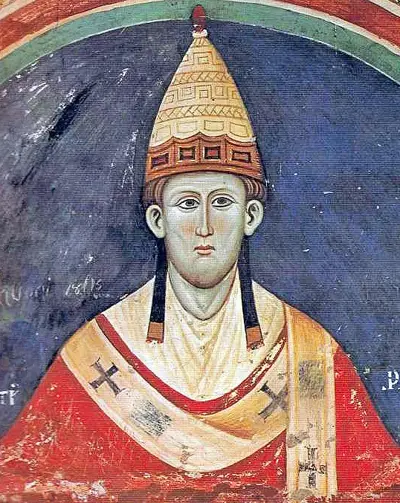
Pope Innocent III was the 176th Pope of the Catholic Church from 8 January 1198 to his death.
