Raoul Salan Quotes
The Army in Algeria is troubled by the recognition of its responsibility towards the men who are fighting and risking a useless sacrifice if the representatives of the nation are not determined to maintain Algeria as French.
Algeria was not a French Colony but an actual province of France where an Algerian had the same citizenship and rights of a Parisian or any other Frenchmen. However the Algerian nationalists combined with the Islamic extremists wanted independence and had started a revolutionary movement primarily using terrorism. Some members of the French Parliament were liberals who thought the Algerians had a right to self-determination and favored a plebiscite; others saw Algeria as a drag on France and were in favor of having it independent. But the majority at that time saw Algeria as a part of France and opposed a change of status. Many in the army however were afraid that the politicians would "sell out" and their sacrifices would have been in vain. This is a common pattern where parts of nations want independence and the military is asked to put down any violence and terrorism. Eventually, the cost in casualties and money became so great that the government did change and allowed Algerian independence—just what the General and many soldiers had feared. In retrospect, the sacrifices were in vain.
Raoul Salan, , French General & Commander of French Forces in Algeria, Telegram to his military superiors in Paris, May 9, 1957
Sourced by: Eigen's Political and Historical Quotations

Nguyen Ai Quoc was early pseudonym. It was many years and millions of combatants sacrificed, but the Vietnamese resistance finally won.


The commander complained of the brutal behavior of Bolivar and the revolutionaries, but the atrocities committed by the Spanish forces were even worse and both sides fought with techniques that had no civilized restraints.


The Indian allies of the French scalped some American colonists which for some whites was akin to the modern reaction to terrorist atrocities. The British and Americans then justified the scalping of their Indian allies as simple retaliation. While Indians had scalped before the whites ever came, the whites accelerated the practice. There was an economic element to scalping. The French “paid” their Indian allies in arms, blankets, trinkets and alcohol by the scalp as it was a crude way of “performance measurement.” Not to be outdone, the English adopted the same custom with the French allied Indians as targets. In North Carolina, for example, the “volunteer” rangers were paid the enormous rate of 10 pounds a scalp.


Americans General William Hull had crossed the Canadian border with 2500 men announcing his intention to invade. Brock’s appeal to the loyalty of English-Canadians to fight off the Americans was in their self-interest as English. He argued that if Canada weakened or the Americans temporarily conquered Canada, they could not hold it, and Napoleon's France would re-colonize Canada. In short, fight against the Americans and keep the French out.


There is a , romantic American myth about the Militiamen in Colonial and Revolutionary America—the citizen soldiers who would leave their farms and rise to the military necessity of the day. However, not only were the militia very hard to muster to duty, but most actually didn’t own or have experience with firearms, and the prevailing opinion of knowledgeable military leaders from George Washington on down was that the militia were not very good soldiers. See {613015}, {613016}, {613022}, {613027}, {621987}, {621988}, {613030}, {613033}, & {613056}

Napoleon was referring to the Elector of Hesse-Cassel. who “rented” his citizens out as soldiers (the Hessians – from Hesse), making money for himself by paying them a fraction of what he was paid for each soldier. Napoleon thought that providing merceneries to other nations for money was an immoral and disgusting thing for a leader to do.


While the official battles of the American Revolution did not begin until 1776, parts of the American colonies were in a de facto state of rebellion and the British could not enforce their laws. See {636925} for another of the King’s statements.
This was written by a French Journalist who had been assigned to America for 7 years when he wrote this in 1939. WWII was just breaking out in Europe.
Louis Napoleon Bonaparte. The “colonies” to which we was referring were the French Colonies in the Caribbean—particularly Haiti. The Black slaves had revolted against the slave-owners and had taken over all positions of authority and wore the uniforms and symbols of power including the epaulettes—the gold braid shoulder pieces that were symbols of high rank in military and diplomatic uniforms which were worn on all official occasions. Napoleon never did make good on his vow. He had many more problems with his own wars and governance in Europe. This quote does demonstrate the racism that existed in supposedly tolerant France.


This quotation shows that the dissent leading to the American Revolution did not emerge suddenly in 1776 after the Battle of Bunker Hill. Dissent, sedition and even violence was documented here in 1774. Salem at the time was the second largest port in the colony and the customs tax collectors—Loyalist Americans—were run out of Salem.
While Mangin was disgustingly racist, many native soldiers from Senegal, Morocco and other French colonies were pleased that Mangin was not only advocating that they serve with the French Army, but the General was critical of the fighting spirt of the then contemporary Frenchmen and claimed that the “prmitives” would invigorate the French Army. Mangin’s view was adopted as policy and in the First World War, native colonial troops were an important component of the victorious French Army.

He had secretly asked the United States to send American troops back to Cuba to help keep law and order as the Cubans could not nor could they govern the polarized society that had been festering under incompetent Spanish rule. President Roosevelt was furious that the Cubans could not govern the country. See {640520}.
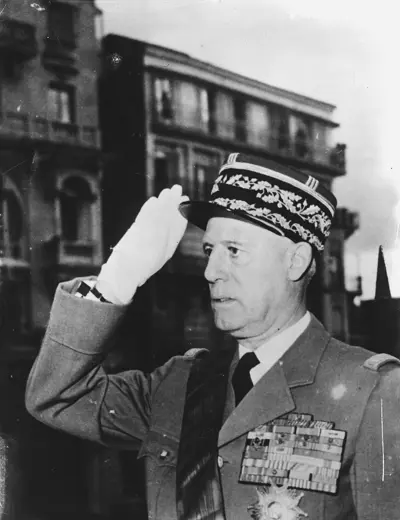
Raoul Albin Louis Salan was a French Army general. He served as the fourth French commanding general during the First Indochina War. He was one of four generals who organized the 1961 Algiers Putsch operation. He was the founder of the Organisation armée secrète and the most decorated soldier in the French Army at the end of his military career.
