Ibn Khaldun Quotes
Such forms of wealth as gold, silver, precious stones are only minerals and products having an exchange value. It is social effort, the search for profit and the use of tools that cause the increase or decrease of the quantity of precious metals in circulation and hence, the real wealth of a King
Ibn Khaldoun, 1332-1406, Tunisian Arab Historian, Sociologist, & Diplomat, Kitab al-Ibar (The Universal History)
Sourced by: Eigen's Political and Historical Quotations

Abd al-Rahman Ibn Mohammad. He is generally regarded to be the World’s first social scientist. The largest statue in Tunisia of not of a military leader of king, but of this social scientist.

Understanding the importance or training, health, and human capital was only one of this man’s remarkable intellectual achievements.


Most of the great industrialists and business people work to create something and change the world somehow. They get rich but that is not typically their major motivation. Most rich people however do not want to trade money for time as they know in a capitalist system rich people can make money without working.

While generally true, Mises here again exaggerates his “proof” by selectively ignoring or being ignorant of counter-examples. The Roman Catholic Church is a classic counter-example where priests, monks, and others owned nothing as individuals, but produced some great science (eg Gregor Mendel), art (the illuminated texts of the middle ages), literature (St Thomas Aquinas, etc). The best counter example that was just evident in the last decade of Misis’ life is Communist Russia. Russian science was better than Fance and Germany and second only to the United States. The Russian ballet and orchestras were second to none. Great literature came out of the Soviet Union and the best of it complained about and attacked the Soviet system of the times. In general, Mises principle tended to be correct throughout history but not always as he dogmatically stated.

Much if the American industrial revolution was assisted by government subsidies of one kind or another. Railroads, telegraph, armaments, foundries are just a few.

Ironically, Fitzhugh who detested socialism, held this basic socialist principle. His solution however, was that the profits were necessary for society, and therefore slavery was the solution for Blacks AND whites.

Economists they world over have differed as to how critical it was to have a money supply that is based on a gold standard or other precious metal. United States history has had a dispute over whether the money should be backed by gold or silver. Finally, under the Richard M. Nixon administration, the United States went off the gold standard and American money ever since is only backed by the ‘full faith and credit’ of the United States. Some politicians like Paul believe this is a poor policy since it allows governments to control their own money supply irrespective of their gold or silver holdings. Paul goes further than most and sees freedom itself dependent on a precious metal standard. Most politicians disagree.

This used to be a generally accepted principle in America. It took labor to produce wealth. It could be someone else’s labor or even slave labor, but labor produced things or labor enabled us to find minerals like gold or oil. However, in modern capitalism, money itself can produce wealth by investing or yielding interest. Inventions produce wealth as do other ideas. Authors and movie producers produce wealth. Who you know can produce wealth (finder’s fees) as can knowledge.


Harvey was one of those who argued that silver and not gold should be the basis of American money. The country was growing and the amount of gold was relatively fixed; therefore money was scarce and many believed the English and American financiers were hording gold deliberately. The final solution was not a gold standard or a silver standard but what we have today—a currency backed only by the full faith and credit of the U. S.
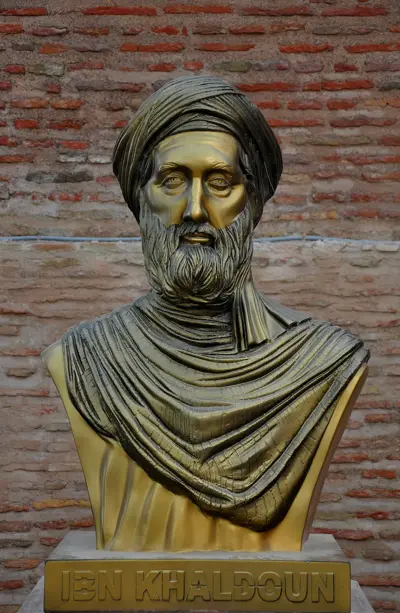
Ibn Khaldun was an Arab sociologist, philosopher and historian who has been described as the founder of the modern disciplines of historiography, sociology, economics, and demography. Niccolò Machiavelli of the Renaissance and the 19th-century European scholars widely acknowledged the significance of his works and considered Ibn Khaldun to be one of the greatest philosophers of the Middle Ages.
