Nat Turner Quotes
Since the commencement of 1830, I had been living with Mr. Joseph Travis, who was to me a kind master and placed the greatest confidence in me; in fact, I had no cause to complain of his treatment of me.
Turner, Nat. The Confessions of Nat Turner, the Leader of the Late Insurrection in Southampton, Va. Thomas R. Gray, 1831, p. 11.

Brown was the richest man in Rhode Island and made much of his money in the slave trade. This quotation shows that slavery was not completely a North verses South split. Northerners like Brown for whose family Brown University was named, was as virulent supporter of slavery as the most ardent Southerner.


Baron Brougham and Vaux


Fitzhugh was a Southern iconoclast whose view of Northern labor was much like that of Karl Marx but who was an enthusiastic supporter of slavery. Fitzhugh was of the opinion that slavery would be reinstated in the North and his treatise agues for that. More and more intellectual opinion was coming to the conclusion that slavery must be abolished or made universal before Lincoln’s famous statement in his debate against Douglas. Although Northerners and Southerners had come to agree on this point, they disagreed about which alternative would and should prevail.

This law required the treatment of Blacks as whites were then treated with respect to indentured servitude—a limit of 10 years after which the person would be free. However, this law was poorly enforced. The “General Court” was the name for the legislature of the Rhode Island colony.


Ruffin is more widely known as the man who fired the first shot of the Civil War.
In early New England the General Court served as both a legislature and a judiciary before separation of powers was introduced. 5 years later the Court banned importing African slaves at all. While slavery was not common in Rhode Island, the laws was not seriously enforced on those who would defy them. It does represent a public anti-slavery sentiment that existed in Early America. It would take 200 years for Rhode Island to finally eliminate all forms of slavery.


Abd al-Rahman Ibn Mohammad. He is generally regarded to be the World’s first social scientist. The largest statue in Tunisia of not of a military leader of king, but of this social scientist.


During the same year England outlawed the slave trade and English citizens and ships from participating in it.

Incredibly, the judges received a higher fee if they found that an accused Negro was a fugitive slave and must be returned, than if he found that it was a case of mistaken identity or the laws of the northern state allowed mandated freedom. Despite the bias, the moral issue was so profound that many Northern judges refused to return fugitive slaves, even after the Fugitive Slave Act.

This is a memorable historical quotations because it shows the extreme level of hypocrisy and lack of logic of which man is capable of when his way of life and world view is threatened. In this case Gordon sees the right to own slaves as a basic civil right. He does not see that the right of possessing slaves totally denies virtually all civil rights to the slave. In his and other Southern views, to assure a man’s liberty he had to have the right and freedom to deny freedom to others, torture others at will, destroy families and remove all hope and aspiration of some people.
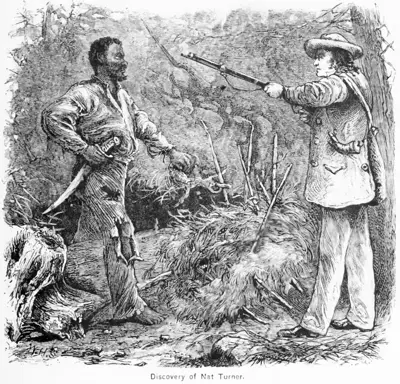
Nat Turner was an African-American enslaved preacher who led the four-day rebellion of enslaved and free black people in Southampton County, Virginia, in 1831. Born into slavery on October 2, 1800, in Southampton County, Virginia, a plantation area with more blacks than whites, Turner was recorded as "Nat" by Benjamin Turner, the man who enslaved him and his family. When Benjamin Turner died in 1810, under then current laws which made human enslavement legal, Nat was inherited as property by Benjamin's son Samuel Turner. For most of his life, he was known as "Nat", but after the 1831 rebellion, he was widely referred to as "Nat Turner". Turner knew little about the background of his father, who was believed to have escaped from slavery when Turner was a young boy. Turner spent his entire life in Southampton County.
