Elihu Root Quotes
Secretary of War Stanton used to get out of patience with Lincoln because he was all the time pardoning men who ought to be shot.
Jessup, Philip C. Elihu Root. Vol. 1, Dodd, Mead & Company, 1938.


At this point, there had hardly been any fighting and no outrages or war crimes were yet committed by either side. These would come later—more on the Confederate side as they did not want to take the limited resources they had from their troops to fulfil abstract obligations to prisoners of war or to civilians. A few deliberately chose to use terror tactics. The Union troops also at various points in the war got out of hand and looted personal property of civilians. But at this point, this proclamation was just lies and propaganda.

When the Confederate Government realized that the Union was planning to arm escaped slaves and induct them into the Union Army, they quickly passed a law that declared any escaped slave who joined the Union Army or wore its uniform was guilty of Treason and would be executed. Most Union Generals one way or another got word to the Confederate Officers that they had better treat all Negro Union Soldiers as prisoners of war. Even President Lincoln warned the South. Butler, however, had a large number of Negro troops in his area and had heard threats of some of the Southerners to execute Black prisoners of war. He had a way of making things very clear, and he was able to prevent murder of any of his Negro troops despite the Treason law.


After the Presidential years of James Buchanan who protected the South from slavery reform and abolition as the North was gaining political power and the abolitionists were having a greater and greater effect on public opinion in the North. While Southerners did not believe Lincoln would emancipate the slaves, they realized that the majority of the growing nation was opposed to slavery, and more and more Northern states were passimg laws making any slave who sets foot in the State a free person. Slaves coud not only have more reason to run away, but slave owners would not be able to get their “property” back. Lincoln would not help the South as Buchanan did, and the Southerners realized that over time, slavery would no longer be feasible or profitable. Cobb, very experienced at Washington politics, realized the changes that would come and thought that they would be “certain and speedy.” The irony was that if the South had not seceded and simply dragged its feet legislatively, it would have taken two or three decades for slavery to end. However, by seceding and initially fighting so hard and well while poor Union generals were in command, Lincoln was forced to try more drastic measures and issued the Emancipation Proclamation after only a few years. The Civil War and seccession was not only a tactical and strategic error for the South, but rapidly brought about just what the Southerners were fighting to prevent.

This is a very important quotation historically. There are a few historians and many politicians who claim that the rebellion of the South in the Civil War was motivated by a number of principles having little or nothing to do with slavery, while most historians have found that slavery was the only major issue. This quote further supports that view. This is the only Union General Officer would be executed if captured by the South. What crimes did he perform to warrant such exceptional treatment? He issued an order Emancipating the Slaves of the Southern Department of which he was the Commanding General. See {619331} . Lincoln quickly countermanded the order, but the act of freeing slaves was to the Southern government so heinous that it deserved the death penalty.

President Bush, who in 6 years had only pardoned or commuted the sentence of 2 people before, commuted the criminal jail sentence of Scooter Libby, the White House Vice Presidential Chief of Staff who had lied to the FBI and the Grand Jury in order to protect the role of White House officials in the illegally leaking the identity of a CIA covert operator to punish her husband—a critic of the administration.


When the Union army began using Blacks as recruits, the South threatened to execute any Negro soldier they captured. Some Southerners opposed execution but favored enslavement of captured Northern Black soldiers. The Lincoln threat seems to have worked, although Lincoln opposed executing Southern officers in retaliation for the atrocities at southern prisoner of war camps

The secretary was urged to resign because President Truman had decided against him on a major policy issue. The only soldier ever so honored

America’s first political economist. This is a wonderful quotation which shows the compromises that even a great president like Abraham Lincoln had to act when Congress passed must have bills.


This Civil War recruiting poster was described by the Free Library of Philadelphia as “Civil War recruitment print targeting African Americans by evoking the freedoms granted by the Emancipation Proclamation. Depicts a montage of symbolic scenes centered around an African American Union soldier triumphantly holding up a sword and an American flag with the banner "Freedom to the Slave." He stands near broken shackles upon a tri-color flag adorned with a coiled snake. The flag is tugged upon by one of three joyous slaves freed by an African American soldier. Other scenes depict an African American man reading a newspaper on a rocking chair near a plow and child, African American children entering a "Public School" near a church, and a regiment of "U.S. Colored Troops" marching across a battlefield strewn with dead bodies.”

When the Senate was debating the Gulf of Tonkin Resolution, which would empower the President to take "all necessary measures" to repel any armed attack on U. S. forces, Senator Morse was one of only two Senators opposing the resolution:
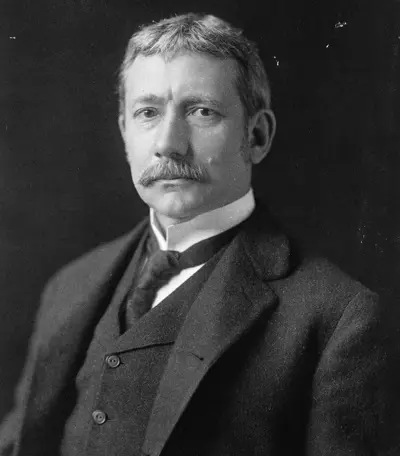
Elihu Root was an American lawyer and statesman who served as Secretary of State under President Theodore Roosevelt and as Secretary of War under Roosevelt and President William McKinley. He moved frequently between high-level appointed government positions in Washington, D.C. and private-sector legal practice in New York City. For that reason, he is sometimes considered to be the prototype of the 20th century political "wise man", advising presidents on a range of foreign and domestic issues. He was elected by the state legislature as a U.S. Senator from New York and served one term, 1909–1915. Root was awarded the Nobel Peace Prize in 1912.
