Robert Burns Quotes
Scots Wha Hae
Burns protest song was immediately itself banned as seditious.
Robert Burns, 1759-1796, Scottish Poet, Song Protesting the Conviction and Sentence for Sedition of Reformer Thomas Muir, 1793
Sourced by: Eigen's Political and Historical Quotations


Song traditionally sung at the end of British Labour Party meetings


Campbell carried out the order although many MacDonalds escaped in the highlands. The particular massacre has always taken on an even greater infamy because the Campbell murderers had been given food and hospitality by the MacDonalds. This began the most bitter of the Scottish clan feuds that persists into modern times.


In South Carolina, the Patriots, in reaction to the Tea Tax, did not destroy the tea, but stopped it from being landed and sold. Finally Lt. Governor Bull had the tea moved into the Customs house in Charleston. The patriots were satisfied that it was under lock and key and could not be sold or distributed and the tea tax was thus not collected. The British Secretary of State for America, however did not regard the compromise favorably.

Several years before the Battle of Bunker Hill, revolutionary activity had already broken out in the American colonies—See {634132} for an example. This law gave the British authorities much more “clout” in dealing with the “seditious” American activities. It protected English law enforcement officials from being tried in local Colonial courts for murder or assault in putting down insurrections. George Washington and other Patriots were outraged over this law. See {634131}.
The Irish Rebellion of 1641 The Rebels wanted to take control of the government and expel the English. However, the Irish rebels got out of control of their leadership and embarked on a number of bloody massacres of what they regarded as English usurpers and destroyers of their Catholic religion. It was the policy of the rebel leadership not to even disturb Scotts. They used the technique to tell the difference between English whose homes should be seized and Scotts who should be undisturbed that the ancient Jews used on the Exodus from Egypt: Marking the lintels of their doorway. The rebels who were so full f hate and demanding of vengeance did not always discriminate and many Scotts were massacred along with the English.


The “Defenders” were the Catholic terrorists who along with their Protestant Orange Order counterpart were in sporadic acts of violence and terrorism with no military objective. The French Army was not to sail for Ireland where they would link up with The Defenders and take Ireland from the English. The invasion failed when terrible weather forced the French troop ships carrying more than 45,000 invading soldiers to cut their anchor cables and return to France.
Ireland, a part of the British Empire, and ruled by the English monarch, had many who celebrated the French Revolution, even as the English Royalists, looked upon France in horror. What is interesting is that the Irish newspaper could actually publish opinions like this which could be argued were treasonous.


There was an hatred of the English—especially for displacing the Roman Catholic Church in Ireland as well as England. See {639436} and {639434}.

This was a rebellion of the Irish natives of Ulster against the English Protestants land owners and the English settlers. In addition to the desire for liberty as this proclamation formally states, the rebels were mostly Roman Catholics whose religion had been almost destroyed the thought by the English component of the Protestant Reformation. 12 years after this proclamation, he was executed.
As a result of Henry VIII establishing himself as the head of the Church in England and Ireland in place of the Pope, Henry’s heirs also became head of the Church. And that was the role that Queen Elisabeth had inherited in addition to the Crown. Many of those loyal to the Pope found most offensive the fact that a woman was making decisions for men and women on matters of faith. A Papal representative travelled with FitzGerald and probably helped him compose this document of which this is but 2 sentences. He may have drafted it completely. The Pope was a factor in many of the Irish rebellions against the English, and this caused great suspicion of all English Catholics whose loyalty to the Queen was in conflict with their loyalty to the Pope who was plotting for a Catholic takeover of England and Ireland.
Irish efforts for independence from England was not only a 19th century and 20th century phenomenon. Here in the 14th century, there was already a war against England. “Lieges” were the nobles loyal to the King.

In most revolutionary settings leaders have to persuade people who have voted with no success to turn to the rifle. In Ireland at this point, almost all the nationalsits knew that the rifle would help them but they were not sure that a vote would have the effect of a bullet.
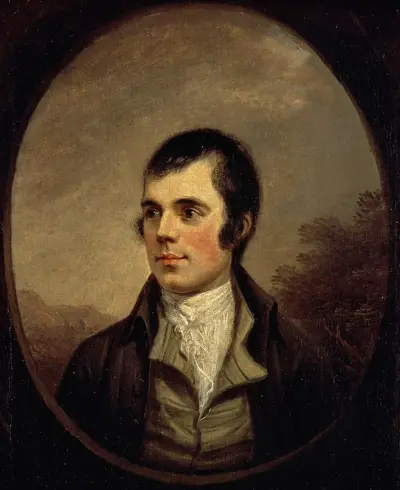
Robert Burns, also known familiarly as Rabbie Burns, the National Bard, Bard of Ayrshire and the Ploughman Poet and various other names and epithets, was a Scottish poet and lyricist. He is widely regarded as the national poet of Scotland and is celebrated worldwide. He is the best known of the poets who have written in the Scots language, although much of his writing is in English and a light Scots dialect, accessible to an audience beyond Scotland. He also wrote in standard English, and in these writings his political or civil commentary is often at its bluntest.
