New York City Quotes
Resolved that a subscription should immediately be set on foot, for the relief of such poor inhabitants of Boston as are, or may be deprived of the means of subsistence, by the act of parliament for stopping up the port at Boston.
The British had closed Boston Harbor until the English merchants who lost their goods at the Boston Tea Party were paid for their damages. Even though Boston being the second port in the colonies after New York were commercial competitors to the New Yorkers. None the less, New York raised money for assistance to the Bostonians who were jobless as a result of the port closure. See {589414} for the other steps that New York was willing to take.
New York City, Resolution, July 6, 1774
Sourced by: Eigen's Political and Historical Quotations

The British had closed Boston Harbor until the English merchants who lost their goods at the Boston Tea Party were paid for their damages. A convention was called to discuss a response to the closing of Boston Harbor and New York City convened a public meeting to come up with instructions for their delegates to the conference. One amazing thing was that they advocated a boycott of English goods. What was amazing was that there was no nation and New York and Massachusetts were separate entities and sectionalism was rife, yet New Yorkers were willing to sacrifice to help Bostonians. The New York sacrifice was all the greater because most of the imports from England landed at New York harbor where there was work created for New Yorkers and business for New York companies. New York stood to lose the most with a boycott. Philadelphia which also advocated a boycott, lost little as they were not a harbor for imports. New Yorkers also provided assistance to their competitors, the Bostonians who were out of work. See {589413}.

Christie was a Tory—a British supporter, but what he did that was so offensive was that he had requested that British Troops come to Maryland to control the rebellion.


2nd Earl of Guilford. This bill cut off all trade with the American Colonies. It was meant as pressure to cease the rebellion. It did not work.

The presence of British troops triggered an angry revolution. Ironically, during the Iraq war, this sentiment was communicated over and over again by Iraqi leaders and held by most peoples who undergo military occupation.


The treaty ending the Revolutionary war guaranteed that the English bankers and merchants who had debts going back to before the American Revo
lution would have “no impediment” in collecting their debts in America. However, Rhode Island and Virginia in particular placed many impediments and made it virtually impossible for debts to be collected in their states. The John Jay led Supreme Court, in particular, overturned state actions on the grounds that they had implemented Patrick Henry’s sentiment and hence violated the treaty.


Americans were by no means united in wanting to take up arms against Britain. Relatively few of the loyalist quotations have come down to us, but here is one. It also illustrates why some Americans wanted complete independence: So that they could escape their debts to English merchants. Most however had more noble and unselfish motives. As a matter of fact, the American Revolution is unusual in the sense that there were so many men of substance who sacrificed much of their material wealth for the American ideal. There were also the rogues and opportunists as Galloway describes.

Brant had an English style Missionary education and was an Anglican, belonging to the Church of England. During the American Revolution, he persuaded most of the Iroquois tribes to fight for the British against the revolutionary colonists. However, the Oneida tribe was not persuaded and joined the rebel side. A few New England Presbyterian missionaries had targeted the Oneida people, and when that tribe chose the “wrong” side, Brant believed that the reason was their different religious point of view. After the Revolution, Brant and his Iroquois followers were driven out of their American lands and escaped to Canada, while the Oneida were given complete title to their lands by George Washington.


Beaumarchais served the French King Louis XVI as a spy and advisor on foreign affairs. He was instrumental in influencing the French King and his government to tilt in favor of the American Revolutionaries.

He was acting as French Foreign Secretary at the time.
This was quite unusual at the time when Kings were more interested in buying the loyalty and support of the rich and powerful nobles.


Marion was the initiator of Guerilla Warfare and he and his men traveled lightly spending much time in the South Carolina swamps. They had few supplies and when chased by the British could not stop to hunt. The British called him the “Swamp Fox”. The American colonists at this point still thought of the British as “their countrymen.”

Executed by the English for his part in the Easter Uprising.

In South Carolina, the Patriots, in reaction to the Tea Tax, did not destroy the tea, but stopped it from being landed and sold. Finally Lt. Governor Bull had the tea moved into the Customs house in Charleston. The patriots were satisfied that it was under lock and key and could not be sold or distributed and the tea tax was thus not collected. The British Secretary of State for America, however did not regard the compromise favorably.

Amazingly, a critical mass of Middle Atlantic citizens, joined in a vision of independence and persuaded their colonies to make common cause with the other colonies to gain independence from England and an end to monarchy. In a way, they had the most to lose and the least to gain from the revolution. Led by Livingston, John Jay, Alexander Hamilton, and Benjamin Franklin and others, these states had the greatest intellectual commitment to the Revolution as they would not financially benefit and would likely lose economically.

The crackdown on Boston which was intended to set an example and intimidate all of the other colonies backfired, and the British were told about it by their own officials in America. But they were so rigid and ideological about monarchy, that the stimulated rebellion rather than suppress them.

Of the 13 colonies, the 3 Middle Atlantic States, were the least enthusiastic about an armed revolution against England. Jersey—Now New Jersey—was the most recalcitrant then with Benjamin Franklin’s son as Governor. See {634108} for an explanation of why that was.

Several years before the Battle of Bunker Hill, revolutionary activity had already broken out in the American colonies—See {634132} for an example. This law gave the British authorities much more “clout” in dealing with the “seditious” American activities. It protected English law enforcement officials from being tried in local Colonial courts for murder or assault in putting down insurrections. George Washington and other Patriots were outraged over this law. See {634131}.

This quotation shows that the dissent leading to the American Revolution did not emerge suddenly in 1776 after the Battle of Bunker Hill. Dissent, sedition and even violence was documented here in 1774. Salem at the time was the second largest port in the colony and the customs tax collectors—Loyalist Americans—were run out of Salem.
during and after the American Revolution
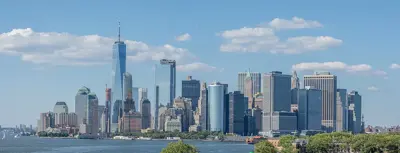
New York City (NYC), often simply called New York, is the most populous city in the United States. With an estimated 2019 population of 8,336,817 distributed over about 302.6 square miles (784 km2), New York City is also the most densely populated major city in the United States. Located at the southern tip of the State of New York, the city is the center of the New York metropolitan area, the largest metropolitan area in the world by urban landmass. With almost 20 million people in its metropolitan statistical area and approximately 23 million in its combined statistical area, it is one of the world's most populous megacities. New York City has been described as the cultural, financial, and media capital of the world, significantly influencing commerce, entertainment, research, technology, education, politics, tourism, art, fashion, and sports, and is the most photographed city in the world. Home to the headquarters of the United Nations, New York is an important center for international diplomacy, and has sometimes been called the capital of the world.
