Patrick Henry Quotes
If we are now to pay these debts to the English, for what were we fighting?
The treaty ending the Revolutionary war guaranteed that the English bankers and merchants who had debts going back to before the American Revo
lution would have “no impediment” in collecting their debts in America. However, Rhode Island and Virginia in particular placed many impediments and made it virtually impossible for debts to be collected in their states. The John Jay led Supreme Court, in particular, overturned state actions on the grounds that they had implemented Patrick Henry’s sentiment and hence violated the treaty.
Patrick Henry, 1736-1799, Member, Virginia House of Burgesses, Member of the Continental Congress, Governor of Virginia, Member, Virginia Constitutional Ratification Convention, Letter, Quoted by Walter Stahr, Lecture, National Archives, March 30, 2005
Sourced by: Eigen's Political and Historical Quotations

While the official battles of the American Revolution did not begin until 1776, parts of the American colonies were in a de facto state of rebellion and the British could not enforce their laws. See {636925} for another of the King’s statements.


Lee at that time was one of the leaders of the American colonists’ cause. He was born in England and was an old friend of Burgoyne who had just arrived in America. Lee wanted to explain the American viewpoint. Lee later became the senior major general under Washington.

This was written more than a year before the American Revolution Battles began. It took time to ship the men and supplies to America and the British did not handle that task with much efficiency. See {636926} for another of the King’s statements.

Wilkes was a strong advocate for the American cause—so much so that some in Parliament tried to deny him his seat in Parliament for his disloyal point of view.

This was written more than a year before the “blows” began. It took time to ship the men and supplies to America and the British did not handle that task with much efficiency.


Fox was one of the opposition leaders who were opposed to the heavy handed policies that the British King and Government had used.


At the time of the American Revolution there were strong abolitionist forces working against slaver and the slave trade. Southern American slave-owners, the political leadership of the South, feared that England would force slavery reforms on their colonies. Hence, severance from England eliminated that threat. In retrospect, they were quite right for it was England which outlawed the slave trade and led the worldwide anti-slavery movement which had little effect on the new independent America and the political bias in favor of the south of the American compact caused slavery to survive in America, long after the vast majority of the population would have it ended. It took the Civil War to do it.


For his seditious activities he was sentenced to penal servitude for life. He escaped and came to America where he entered politics

Most Canadians supported the English despite the letter.


In most revolutionary settings leaders have to persuade people who have voted with no success to turn to the rifle. In Ireland at this point, almost all the nationalsits knew that the rifle would help them but they were not sure that a vote would have the effect of a bullet.


The Congress was encouraging all men volunteer for the military and defend the new nation now that the British were landing in force to put down the revolution. By modern language standards, this is a little “over the top” but it shows not only the passion felt by the Congress but the importance they placed on the struggle.
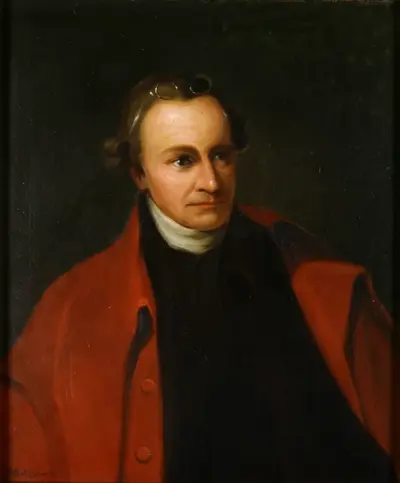
Patrick Henry was an American attorney, planter, politician, and orator best known for his declaration to the Second Virginia Convention (1775): "Give me liberty, or give me death!" A Founding Father, he served as the first and sixth post-colonial Governor of Virginia, from 1776 to 1779 and from 1784 to 1786.
