Ruth Bader Ginsburg Quotes
Racial discrimination in elections in Texas is no mere historical artifact. To the contrary, Texas has been found in violation of the Voting Rights Act in every redistricting cycle from and after 1970.
Shelby County v. Holder. 570 U.S. 529, Supreme Court of the United States, 25 June 2013. Dissenting opinion by Justice Ginsburg.


At the time Negroes were prohibited from voting by a series of discriminatory criteria for voter registration and intimidation so that Blacks would not generally even try to register. But the Civil Rights movement changed tactics and organized large scale attempts at voter registration. Mayor Thompson and the white power structure of the town were not going to allow that. They had not only enlarged the police department but the city purchased an a small armed tank.

Preclearance was a requirement that any change in the voting or registration laws, rules or procedures needed to be approved by the Federal Justice Department. He was testifying about why preclearance was important and why it was placed in the Voting Rights Act every time it was reauthorized. See {635271} for what happens without preclearance.

The President was asking for passage of his Voting Rights Bill.


In 1895, a Constitutional Convention was held in South Carolina in which there were no Republicans allowed and no Negroes despite the fact that 60 percent of the population at the time was Black. The constitution was do written that it would go into effect without being submitted to the people for any kind of ratification or approval. Essentially a tiny minority of wealthy white men of one particular persuasion not only determined the political future of the state, but also defined the requirements for voting so that this minority could perpetuate itself thereafter.

Surprisingly to most of us, Indians and Blacks could vote in Virginia before 1723. They could even hold public office until 1705 when Virginia passed a law banning that. See Quotation 643587. 18 years later the Virginia legislature also outlawed these minorities from voting as this quotation demonstrates.


Preclearance was a requirement that any change in the voting or registration laws, rules or procedures needed to be approved by the Federal Justice Department.

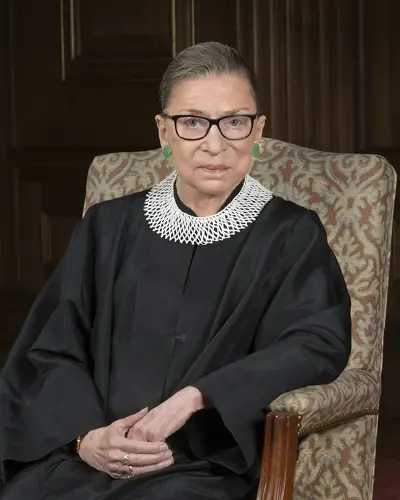
Joan Ruth Bader Ginsburg was an American lawyer and jurist who served as an associate justice of the Supreme Court of the United States from 1993 until her death in September 2020. She was nominated by President Bill Clinton, replacing retiring justice Byron White, and at the time was generally viewed as a moderate consensus-builder. She eventually became part of the liberal wing of the Court as the Court shifted to the right over time. Ginsburg was the first Jewish woman and the second woman to serve on the Court, after Sandra Day O'Connor. During her tenure, Ginsburg wrote notable majority opinions, including United States v. Virginia (1996), Olmstead v. L.C. (1999), Friends of the Earth, Inc. v. Laidlaw Environmental Services, Inc. (2000), and City of Sherrill v. Oneida Indian Nation of New York (2005).
