John Marshall Quotes
Ports not effectually blockaded by a force capable of completely investing them have yet been declared in a state of blockade.... If the effectiveness of the blockade be dispensed with, then every port of the belligerent powers may at all times be declared in that state, and the commerce of neutrals be thereby subjected to universal capture. But if this principle be strictly adhered to, the capacity to blockade will be limited by the naval force of the belligerent
The problem of fictitious blockades vexed the world until 1856. See {613802}.
John Marshall, 1755-1835, Chief Justice of the U. S. Supreme Court, U. S. Congressman (Federalist, VA), U. S. Secretary of War, U. S. Secretary of State, Letter to Rufus King, minister to England, September 20, 1800
Sourced by: Eigen's Political and Historical Quotations


The British had closed Boston Harbor until the English merchants who lost their goods at the Boston Tea Party were paid for their damages. A convention was called to discuss a response to the closing of Boston Harbor and New York City convened a public meeting to come up with instructions for their delegates to the conference. One amazing thing was that they advocated a boycott of English goods. What was amazing was that there was no nation and New York and Massachusetts were separate entities and sectionalism was rife, yet New Yorkers were willing to sacrifice to help Bostonians. The New York sacrifice was all the greater because most of the imports from England landed at New York harbor where there was work created for New Yorkers and business for New York companies. New York stood to lose the most with a boycott. Philadelphia which also advocated a boycott, lost little as they were not a harbor for imports. New Yorkers also provided assistance to their competitors, the Bostonians who were out of work. See {589413}.

this quotation is one of the first references to Siam. It also illustrates the drive for trade. Malacca was a trading center but the King who was constantly in war with Siam did not want to allow the Siamese ships to bring their goods into his port to trade with the Europeans. A Portuguese had an interesting and novel concept of free trade. That and they should be free to trade with anyone in Asia, anywhere, so long as other European nations were not. Siam however was a much larger kingdom and Malacca and had much more skilled artisans and a greater variety of products. Therefore, Portugal sided with what Alfonso de Albuquerque decided would be its best supplier in the area.


Ransome had a unique access to Post Russian Revolutionary leadership as his fiancée was the secretary to key Russian Communist party committees and through her he had access to Lenin, Trotsky and other leaders. In general Ramsome is best known as a children’s book author.


The United States had no navy at that point.

The issue of free trade verses protectionism has been with us throughout American history with national sentiments going one way and then later the other, only to come back and the cycle has gone on. Floyd was very modern in his economic views, so much so that he, even as a Southern politician, opposed slavery on the grounds that it was economically inefficient and the South would never develop industrially if it had no incentive, as existed in the North and England, to reduce the amount of labor required for economic opportunity. He was right on that point as well.
He had introduced a bill to provision a military garrison at the mouth of the Columbia River on the West Coast and protect and develop trade with China and India. President Monroe was for it and he persuaded the House to vote for it, but the bill to encourage foreign free trade with the Orient died in the Senate. Floyd was another American ahead of his time. . Floyd was very modern in his economic views, so much so that he, even as a Southern politician, opposed slavery on the grounds that it was economically inefficient and the South would never develop industrially if it had no incentive, as existed in the North and England, to reduce the amount of labor required for economic opportunity. He was right on that point as well.

This is a particular fascinating quotation. First because the American liquor trade and Prohibition are paralleled to the opium trade in China. Second, is illustrates that the opium growing problem of the 21st century was virtually the same as that which existed at the beginning of the 20th century. The only difference is that the location moved from China to Afghanistan.


This is one of the earliest examples of the establishment of a type of Commerce Department – a government institution to look after the commercial affairs of the state.
This is the origin of one of the first Departments of Commerce.


Most Americans do not realize that our naval forces were disbanded after the Revolution and even the Constitution did not require a navy. We had some Federal revenue cutters to interdict smugglers but no warships and no permanent sailors or officers. The Barbary Pirates had an incredible extortion racket going in the Mediterranean. If nations would pay them an annual sum each year, they would not attack and seize merchant ships of that country and sell the ships and goods while holding the sailors for ransom. See {640850},86703,{640846} & {640848}

[These new "extra fees" for baggage, schedule changes, getting a good seat, etc are a new in the industry where most of the few airlines would rather match the fares and fees of the rest, rather than compete and get a larger market share. Interestingly, the best run and most profitable airline, Southwest, does not charge most of these new fees. Also, the airlines business has over the years not been very profitable. The nature of the industry makes it difficult for most airlines to make steady profits year after year, so many tend to be hogs and take advantage of consumers whenever they had the opportunity.]

Arguing that Slavery inhibited a society from development ...


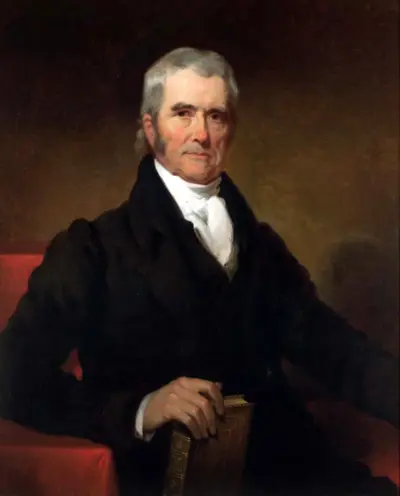
John Marshall was an American politician and lawyer who served as the fourth Chief Justice of the United States from 1801 to 1835. Marshall remains the longest-serving chief justice and fourth-longest serving justice in Supreme Court history, and he is widely regarded as one of the most influential justices to ever sit on the Supreme Court. Prior to joining the Supreme Court (and for one month simultaneous to his tenure as Chief Justice), Marshall served as the United States Secretary of State under President John Adams.
