W. Averell Harriman Quotes
Poland, of course, was the key country. I remember Stalin telling me that the plains of Poland were the invasion route of Europe to Russia and always had been, and therefore he had to control Poland.
Harriman, W. Averell, and Elie Abel. Special Envoy to Churchill and Stalin, 1941-1946. Random House, 1975.


Many people mistakenly believe that this was the first political use of the “iron curtain” phrase—in German, “eiserner vorhang.” However, George Washington Crile used the phrase in 1915 {598870}. It is not known whether Geobbels knew of Crile’s work, or if Winston Churchill in his famous speech {411311} was familiar with either Crille’s or Goebbels use.


This was the most famous public use of the term "iron curtain" in the cold war. Churchill had used the term privately in an even earlier cable to President Truman. However, the phrase "iron curtain" was used by T. St. Vincent Wallace Troubridge even a few months earlier. Also, it appears to have been used earlier than that by Nazi Propaganda Minister Joseph Goebbels in Das Reich {601664}. But George Washington Crile used the phrase in a political context in 1915 {598870}. And Viscountess Snowden used the phrase in her memoirs of a Past WWI trip to Russia {616546} It is not known whether Troubridge or Churchill were familiar with those works.


FDR was right about Russia being a major factor in stopping Hitler, but partially wrong about the danger of Russia. The Soviets never did dominate Europe although the tried, but they did dominate Eastern Europe.


After the breakup of the Soviet Union, NATO expanded to include some fo the former Soviet Nations thus moving NATO territiry to the East--closer to Russia, whose leaders percieved that the expansion was hostile and dangerous for the indpendence of Russia. What made the situation more complex is that the American Secretary of State, when the Soviet Union was very powerful, had made an agreement with the Soviets that in return for Russian aquiessance of NATO being extended to East Germany, NATO would not expand further West. But after the collapse of the Soviet Union, Russia was quite weak and NATO expanded east despite the earleir comittment. The US and th eother NATO counties took the pozition the previous comitmnts were not binidng as they were never formally signed. The Russians then decided to take a hard line position and flaunt and use military force to which would stop the Western expansion closer to the Russian border.

Ironically, at the time she wrote this column, Mrs. Roosevelt was being accused of being a communist by some Southerners who associated her strong views against racism and segregation. Some in the North thought she was a communist because of her active role in the New Deal, Yet here she was, willing to use military force to prevent Soviet expansion.

The Russian troops, killed more Germans and liberated more territory than the rest of the Allies together. They also suffered many more casualties than the rest of the Allies.

He served as a liaison with the Russian military officers after WWII. As a result he developed friendships with some who told him much about Stalin and the Communist party of the Soviet Union.


1st Viscountess Snowden. See Winston Churchill regarding the most famous use of the “iron curtain” phrase {411311}. She seems to have been an earlier user. The phrase " iron curtain" was used by T. St. Vincent Wallace Troubridge a few months earlier than Churchill. Also, it appears to have been used earlier than that by Nazi Propaganda Minister Joseph Goebbels in Das Reich {601664}. But George Washington Crile used the phrase in a political context in 1915 {598870}. And Viscountess Snowden used the phrase in her memoirs of a Past WWI trip to Russia {616546}. It is not known whether Troubridge or Churchill were familiar with any of these other works.
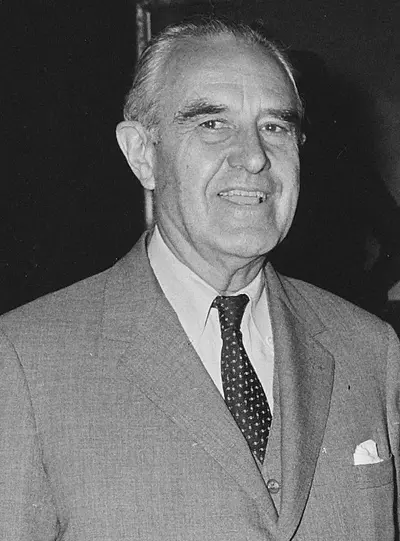
William Averell Harriman, better known as Averell Harriman, was an American Democratic politician, businessman, and diplomat. The son of railroad baron E. H. Harriman, he served as Secretary of Commerce under President Harry S. Truman, and later as the 48th Governor of New York. He was a candidate for the Democratic presidential nomination in 1952 and 1956, as well as a core member of the group of foreign policy elders known as "The Wise Men".
