Fisher Ames Quotes
Our commerce is on the point of being annihilated, and unless an armament is fitted out, we may very soon expect the Algerians on the coast of America. .
He was referring to the Algerian Barbary Pirates who had an incredible extortion racket going in the Mediterranean. If nations would pay them an annual sum each year, they would not attack and seize merchant ships of that country and sell the ships and goods while holding the sailors for ransom. Ames was well known for his hyperbole and fear of all the worst possible consequences. He was in many ways like some of the Tea Party of the 21st century who saw immigrants taking over the country and Muslim terrorists in attack on the United States. The Algerians did not have the inclination, skill, or shipbuilding skill to handle trans-Atlantic travel.
Fisher Ames, 1758-1808, U. S. Congressman (Federalist, MA), Quoted in Joseph Wheelan, Jefferson’s War
Sourced by: Eigen's Political and Historical Quotations

Marie Joseph Paul Yves Roch Gilbert du Motier. The Barbary Pirates had an incredible extortion racket going in the Mediterranean. If nations would pay them an annual sum each year, they would not attack and seize merchant ships of that country and sell the ships and goods while holding the sailors for ransom.

Most Americans do not realize that our naval forces were disbanded after the Revolution and even the Constitution did not require a navy. We had some Federal revenue cutters to interdict smugglers but no warships and no permanent sailors or officers. The Barbary Pirates had an incredible extortion racket going in the Mediterranean. If nations would pay them an annual sum each year, they would not attack and seize merchant ships of that country and sell the ships and goods while holding the sailors for ransom. See {640850},86703,{640846} & {640848}

The Barbary Pirates had an incredible extortion racket going in the Mediterranean. If nations would pay them an annual sum each year, they would not attack and seize merchant ships of that country and sell the ships and goods while holding the sailors for ransom.
He was referring to attacking the Barbary States. The Barbary Pirates had an incredible extortion racket going in the Mediterranean. If nations would pay them an annual sum each year, they would not attack and seize merchant ships of that country and sell the ships and goods while holding the sailors for ransom. See {640846}.

See {640847}, {640845} & {640846}. The capitalization is exactly as Adams wrote it. Note the omission of a capital letter for “congress” for whom he and many others had little respect even then.
Adams urged paying tribute to the Barbary Pirates who had an incredible extortion racket going in the Mediterranean. If nations would pay them an annual sum each year, they would not attack and seize merchant ships of that country and sell the ships and goods while holding the sailors for ransom. Most of the European powers were paying the annual tribute as they calculated that it was cheaper than patrolling the Mediterranean with warships or going to war with the Barbary States. More important for Adams was that he did not think that the country would support such a military action. See {640847} That was Adams’ thinking. Jefferson however, sent our Navy and Marines to our first foreign war, and they were very effective. However, despite the American military victories, and because of the inability for the European powers to collaborate and share the burden of naval patrol, the United States went back to the craven policy of paying the blackmail. See {640846} & {640848}.

The Barbary Pirates had an incredible extortion racket going in the Mediterranean. If nations would pay them an annual sum each year, they would not attack and seize merchant ships of that country and sell the ships and goods while holding the sailors for ransom. There were political differences in America over whether to pay tribute and ransom or respond militarily.

The Barbary Pirates had an incredible extortion racket going in the Mediterranean. If nations would pay them an annual sum each year, they would not attack and seize merchant ships of that country and sell the ships and goods while holding the sailors for ransom. President Jefferson had first dispatched American warships and authorized a major land operation which were very effective. Finally, a treaty was negotiated but Decatur reminded the Navy of what brought the Algerians to the negotiating table.

While to Madison the principle that “war is better than tribute” was “settled policy”, there were many who disagreed. See {640867} as an example.
This quotation was reported to Congress by Thomas Jefferson. Essentially, this religious justification is no different from that made by contemporary Islamic extremists. Particularly interesting is the last sentence. The Koran states that all Muslims who die defending Islam will go immediately to heaven regardless of their previous sins and transgressions. Under that justification, even criminal extortion and terrorism is justified by some Muslims whenever the victims are non-believers.

In the 18th Century, the Islamic Barbary States combined their religious beliefs for Jihad against non believers with a classic criminal enterprise. They would authorize cosairs to outfit ships and attack Christian merchant ships on the high seas. They would capture the ship and the cargo, which would be split with the ruler of the country. The crew and passengers would by “rented out” as slaves until they would be ransomed, the proceeds of which would also be shared. To motivate a larger ransom, the captives were regularly tortured as well as worked almost to death. The Barbary Pirates encouraged the “slaves” to write to their relatives, friends and governments to try and raise the ransom. O’Brien’s ship was captured in 1785. He had been a slave for 4 years when he wrote this. See {623704} for a quote from a letter he sent Congress. Finally, after 10 years, O’Brien and those of his crew that were still alive were finally freed. O’Brien’s unusual experience and knowledge of the Barbary States qualified him as an expert and he was then appointed Consul-General to Algiers. Individual Christian countries were offered a “treaty” whereby for an annual payment of tribute to the Barbary country, the corsairs of that country would not attack ships flying their flag. The Christian country had to make 4 different tribute payments to each of the Barbary nations. Most of the European powers were paying the tribute even though some could easily defeat the Corsair navies in a war. The cost of outfitting a fleet for war was much more costly than paying the tribute. The new nation of the United States was good pickings for the Barbary pilots and there was a period of several decades where the Americans had to create a policy to pay tribute or go to war. At different times America did both.
In the 18th Century, the Islamic Barbary States combined their religious beliefs for Jihad against non believers with a classic criminal enterprise. They would authorize cosairs to outfit ships and attack Christian merchant ships on the high seas. They would capture the ship and the cargo, which would be split with the ruler of the country. The crew and passengers would by “rented out” as slaves until they would be ransomed, the proceeds of which would also be shared. To motivate a larger ransom, the captives were regularly tortured as well as worked almost to death. The Barbary Pirates encouraged the “slaves” to write to their relatives, friends and governments to try and raise the ransom. O’Brien’s ship was captured in 1785. He had been a slave for 4 years when he wrote this. See for a quote from a letter he sent Congress. Finally, after 10 years, O’Brien and those of his crew that were still alive were finally freed. O’Brien’s unusual experience and knowledge of the Barbary States qualified him as an expert and he was then appointed Consul-General to Algiers. Individual Christian countries were offered a “treaty” whereby for an annual payment of tribute to the Barbary country, the corsairs of that country would not attack ships flying their flag. The Christian country had to make 4 different tribute payments to each of the Barbary nations. Most of the European powers were paying the tribute even though some could easily defeat the Corsair navies in a war. The cost of outfitting a fleet for war was much more costly than paying the tribute. The new nation of the United States was good pickings for the Barbary pilots and there was a period of several decades where the Americans had to create a policy to pay tribute or go to war. At different times America did both.

The plan was to have an American agent with a few marines make an alliance with a rival to the throne of Algiers and depose the existing ruler with American “special forces”.

In the 18th Century, the Islamic Barbary States combined their religious beliefs for Jihad against non-believers with a classic criminal enterprise--piracy. They would authorize corsairs to outfit ships and attack Christian merchant ships on the high seas. They would capture the ship and the cargo, which would be split with the ruler of the country. The crew and passengers would by “rented out” as slaves until they would be ransomed, the proceeds of which would also be shared. To motivate a larger ransom, the captives were regularly tortured as well as worked almost to death. The Barbary Pirates encouraged the “slaves” to write to their relatives, friends and governments to try and raise the ransom. Individual Christian countries were offered a “treaty” whereby for an annual payment of tribute to the Barbary country, the corsairs of that country would not attack ships flying the flag of the country that paid the tribute. The Christian country had to make 4 different tribute payments to each of the 4 Barbary nations. Most of the European powers were paying the tribute even though some could easily defeat the Corsair navies in a war. The cost of outfitting a fleet for war was much more greater than paying the tribute. The new nation of the United States was good pickings for the Barbary pirates and there was a period of several decades where the Americans had to create a policy to pay tribute or go to war. At different times America did both. Jefferson argued for War rather than pay the blackmail tribute.

The Barbary Pirates had an incredible extortion racket going in the Mediterranean. If nations would pay them an annual sum each year, they would not attack and seize merchant ships of that country and sell the ships and goods while holding the sailors for ransom. See {640845} ,{640846} & {640848}

Opponents claimed that it would be dishonorable to negotiate with terrorist states and to pay ransom at any time. This tension between principle and empathy with American prisoners first emerged in the Barbary Wars, but has been with America ever since. Our policy position of honor vis a vis terrorists has been the same since then. We do not negotiate. However, exceptions have been made many times in American history, as it was here thanks to military leaders like Barron. This was the origin of the military tradition of never leaving Americans behind in when they have been captured in conflicts that was so contentious such as the Afghanistan and Iraq Wars.

The American sailors had been captured and were being held for ransom by the Barbary Pirates in terrible conditions. The pirates stated that they were slaves and would be sold if the United States did not come up with enough ransom money. After much debate in America, a squadron of Naval Troops had been dispatched to the Mediterranean where they would “negotiate” with cannon—attacking the ports of the Barbary States.

Dreadnoughts were huge battleships. Britain had the dominant navy of the world and controlled the seas. A European war would be a land war where a navy would be of little use. Hence, Britain would not want to get involved in such a war where she could not use her greatest military strength. He was wrong about this and so much else. Britain entered WWI when Germany invaded Belgium fulfilling her treaty obligations. The Germans intelligence operators and analysts were well aware of the treaty obligations, but had little understanding of English culture and tradition. The German aggression against a small power like Belgium was morally offensive to many in Great Britain, and Britain had a tradition of fighting for moral principles. The Germans would never militarily disadvantage themselves for the sake of a treaty obligation to a small nation, and they did not believe that the British would be so different and fulfill their treaty obligations even though their strongest military asset—their navy would not be very helpful.


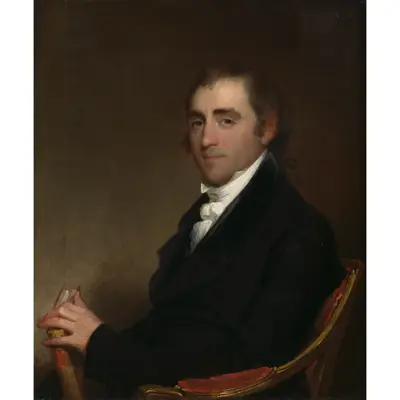
Fisher Ames was a Representative in the United States Congress from the 1st Congressional District of Massachusetts. He was an important leader of the Federalist Party in the House, and was noted for his oratorical skill.
