Leo Tolstoy Quotes
… only through stopping every measure of force on the part of the government—not only the executions, but the arrests and banishments—could this fearful, animal-like fight of a people be stopped.
The pamphlet was banned in Russia but was published in Germany and other parts of Europe.
Leo Tolstoy, 1828-1910, Russian Writer & Philosopher, Pamphlet, Social Liberty, April 1907
Sourced by: Eigen's Political and Historical Quotations


The demonstration was on August 8, 1643. There are several important aspects to this quotation. First, it shows that a peace movement is not only a creature of modern times. Second, that women were actively involved in political protests and demonstrations in 17th century England. Last, that the police of the time behaved as brutally as many police forces do in later centuries in putting down and surpressing demonstrations.

This quotation is used by the moderate Egyptians and other moderate Arab leaders as well as Israelis and other experts in combating Islamic Fundamentalism to illustrate the thinking process of the Muslim fundamentalist terrorist leader. They are more than willing to sacrifice those they lead (though rarely themselves) if they think that something is to be gained. But if there is nothing to be gained, their “moral” responsibility requires not “wasting” their followers’ lives. Therefore, the way these experts believe they should deal with the radicals is to face them with overwhelming force (a variant of the Powell Doctrine) and never concede anything or let them gain anything from violence. A single concession makes the terrorism, sacrifice and violence worthwhile, but if there is no gain, the leader has wasted the lives of his followers and is less likely to initiate another attack.


Vladimir Lenin

then KGB leader. Khrushchev had rounded up and arrested an assortment of dissidents and non enthusiastic communists It was to culminate in 8 million arrests and 1 million executions.


Stalin did not want any political opposition with its own militia. American gun control opponents often cite this quotation to show that in Russia, Stalin achieved dictatorial power by disarming the population in general and only allowing government officials to have guns. They argue that even Stalin could not have tyrannized the entire Soviet Union if every citizen had the right to bear arms as provided for by the Second Amendment.
Vladimir Lenin. One of the claimed benefits of Capital Punishment has always been the inhibition of others, but it turned out that it was never very effective at that. However, prevention was Lenin’s major objective so he ordered public hanging instead of shooting—the usual method of execution at the time. This infamous quotation started the new Russian government off on a horrible record of civil and human rights. The people hanged were not particularly guilty of any crime. They were just people who had gotten, or whose family was, rich under the Czar. The disregard for rule of law was most dramatically evidenced by this Lenin order. Needless to say, rich people the world over, saw a great threat to their lives from this new state wanting to export its philosophy.


Lev Davidovich Bronstein

At the time many physicians believed that “bleeding” patients would contribute to their health. So bloodletting was then a standard medical treatment.

Referring to the Bureau of Alcohol, Tobacco and Firearms:


She was one of the early abolitionists. Despite the Southern attempted repression of information of slave resistance, some of the facts emerged and were well known in the North. The South tried to suppress these incidents lest other slaves get ideas from it. Also the Southerners often maintained that Africa was so primitive and underdeveloped, that the slaves were better off in America; these actions of rebellion belied this notion.
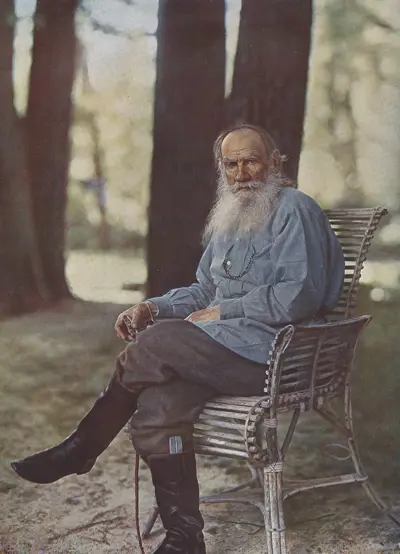
Count Lev Nikolayevich Tolstoy, 9 September, 1828 – 20 November, 1910), usually referred to in English as Leo Tolstoy, was a Russian writer who is regarded as one of the greatest authors of all time. He received nominations for the Nobel Prize in Literature every year from 1902 to 1906 and for the Nobel Peace Prize in 1901, 1902, and 1909. That he never won is a major controversy.
