Rutherford B. Hayes Quotes
One of the tests of the civilization of people is the treatment of its criminals.
Hayes, Rutherford B. "President's Address." Proceedings of the Annual Congress of the National Prison Association, R. R. Donnelley & Sons, 1886, p. 10.


This interesting historical quotation illustrates the fact that in almost every American generation there are those who believe that society has gone too far in protecting the rights of criminal suspects at the expense of law and order in the general society. This is nothing new. This is a classic argument given by those who would deny a defendant the Constitutional protection against self-incrimination. The belief that an innocent man has nothing to fear from the police is refuted by the many cases of innocent men being convicted by evidence they have given in the belief that they were innocent, and served long jail sentences only to later be proved by DNA evidence that they could not possibly have been guilty. Since Nott’s day, society has not only found many cases where honest error was made by the police or prosecutors, but many where there was venal prosecutorial misconduct and defendants were jailed even though the authorities were aware of evidence of innocence and kept it secret. There have been a number of these cases where a defendant was on death row and about to be executed when it was found he was innocent. Probably there have been men wrongly executed. See {629444} for a probable example.

Most people reading this think at first that if comes out of the Middle Ages, but it is quite contemporary expressing a point of view that holds that the state is but the instrument of and subservient to God as defined by Protestant Fundamentalism.


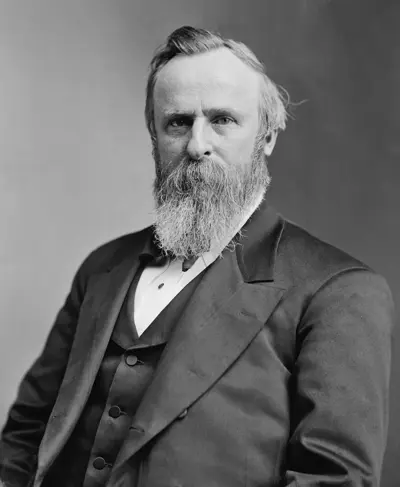
Rutherford Birchard Hayes was an American politician and attorney who served as the 19th president of the United States from 1877 to 1881, after serving in the U.S. House of Representatives and as governor of Ohio. A lawyer and staunch abolitionist, he had defended refugee slaves in court proceedings during the antebellum years. He negotiated the political agreement to end federal support of Reconstruction.
