Niall Ferguson Quotes
One of the main arguments that I make in my new book, 'The Great Degeneration,' is that the rule of law in the U.S. is becoming the rule of lawyers.
Ferguson, Niall. "Niall Ferguson on 'The Great Degeneration'." The Telegraph, 11 Jun. 2013.


Mises is one of the very few economic conservatives who opposed companies getting involved with lobbying or politics in any way. He, like some others, saw the negative public effect that business produces when it does get deeply involved in politics, but he uniquely observed that the businesses themselves suffered as a result of the involvement in politics. Obviously very few business leaders of the 21st century agreed with Mises’ earlier views.

He made this quotation when he was a member of the Wisconsin State legislator. He was describing the influence and interaction that corporations had with the Wisconsin state legislative process.


His unusual theory was that if government could or did not do much to affect the economy, there would be no reason for a large corporation to invest money in electing a particular party or candidate. Therefore the way to get the influence of big money out of politics is to reduce the role of government drastically. Paul was one of the very few Conservative politicians who would publicly state that the reasons that corporations made campaign contributions was to buy political favors, favorable legislation or tax treatment. If corporate investments did not pay off for the company, shareholders would not tolerate spending investment money for a particular political philosophy as most companies have shareholders representing the range of American political opinion and their investments should pay off to the bottom line—profits.


The State Department has always been reluctant to have the US Government make an official condemnation of the Turkish. Prior to the end of WWI. Turkey’s Ottoman Empire controlled most of the Middle East which was discovered to be full of oil. Armenia had no oil. The State Department since then (and until the 1970s) it has made it a top priority to advocate for Standard Oil and other American oil companies with the Turks and then the Arabs regardless of the morality of the situation. Despite the fact that virtually every American leader wanted to advocate for the Armenians, the State Department held fast to not
upset Turkey about the Armenian Genocide. Cardashian was the first American who openly stated what the real motivation was. See {638251}, {620602}, {620603}, {620604}, {620605}, and {620606}

Rove had bridged the traditional gap between the right wing Religious fundamentalists and large business, industrial, heavy donors to the party. These groups usually diverged on economic policy and cultural values however Rove had convinced both that they should tolerate the other for the sake of maintaining power for President George W. Bush who delivered enough to each to hold them in coalition. Rove’s style tended to moralize everything for the religious right including their cooperation with major exploiters of economic self-interest. Rove’s religious tactics which were so successful was a subject of great interest and analysis, especially since Rove himself was an agnostic.

The two law enforcement officers had testified that they arrested demonstrators who had “come to break the law” and had not at that point broken any laws.


Trump often used the phrase "Drain the swamp" in his campaigning to mean get ride of the establishment figures who had, for the most part, dominated politics, for decades. When he was elected, he had to appoint a cabinet, but when he did so, it was almost exclusivly made up of people who had been a part of the political and corporate establishment -- the swamp.


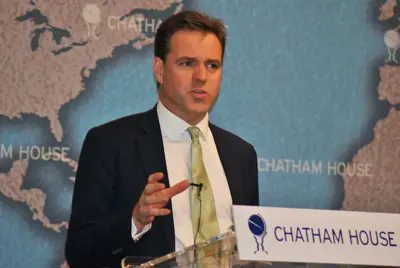
Niall Campbell Ferguson is a Scottish historian and the Milbank Family Senior Fellow at the Hoover Institution at Stanford University. Previously, he was a professor at Harvard University, the London School of Economics and New York University, visiting professor at New College of the Humanities and senior research fellow at Jesus College, Oxford.
