Henry L. Stimson Quotes
One is treading on very delicate ground when you have to consider the public opinion in China, Japan, the League of Geneva, and at home. It is pretty hard to avoid using a word which may arouse unintended repercussions in one or the other of those half a dozen localities
Henry L. Stimson, 1867-1950, U. S. Secretary of State (Republican), U. S. Secretary of War, Governor General, Philippine Islands, Diary, October 9, 1931
Sourced by: Eigen's Political and Historical Quotations


He argued to take every statement or threat of violence against America or Americans made by a foreign leader, even if for local political purposes, as a clear and present danger that requires action, often including force to nullify that country's capability to harm America or to produce a regime change. Many point to Adolf Hitler who had, in Mein Kampf, told the world what he would try and do, and few paid any attention to him. On the other hand, when he was at his most dangerous and planning massive world aggression, his rhetoric was very moderate and peaceful. The vast majority of the foreign leaders who threaten America and her interests, never have acted on those threats. However, one danger is the incitement of others in the country or region who might become a threat to America as an individual or a non state terror group.


Kissinger had observed in his unpopular view that he was saying exactly what the George W. Bush administration had officially said on several occasions. This response is quoted by those who use it as an example of how low the reputation of the George W. Bush administration had sank with America’s foreign allies. Kissinger was seen as a much more important and influential factor despite the fact that he had been out of office for over two decades. At the time, many American allies had given up on Bush and because he was so unpopular with Americans as well as foreigners, they assumed that his statements would not represent American policy or opinion as soon as Bush’s term was over. The new President of whichever party would, it was assumed, repudiate most of the Bush actions and try and rebuild America’s shattered reputation. In that scenario, Kissinger’s views would not only be more representative of American positions than that of Bush and his diplomatic representatives.

At the time Pakistan was almost a failed state which had nuclear weapons. They took large amounts of American aid (military and civilian) and claimed that they were an ally in the War on Terror. On some occasions they deployed their troops against fundamentalist terrorists. On others they shielded terrorists and provided them with sanctuary from attack, intelligence and allowed terrorist leaders to not only live in Pakistan but operate their organizations from Pakistan. They supported radical Madrassas (religious schools) that taught hate and terrorism, and armed terrorists in the hopes that they could be used against their enemy India while the terrorists themselves killed more Pakistanis by far than the Indians ever did. The civilian government was subservient to the military which itself was subservient to the Intelligence Arm.


The inscrutability of the “oriental” was not racial as Nicholson and many others thought as most Asians who became Westernized tend to behave and respond to the Western culture in which they were brought up. However, many of the “oriental” cultures place a premium on inscrutability and avoidance of candor. Therefore, often they interact with Westerners and are unsure of the certainty of what they hear and observe. Or they hear it in ways that in their culture would not indicate strong feeling when that was intended by the Westerner. For example, Arab oratory tends to repeat something intensely felt several if not many times. A Western Diplomat who thinks he “makes himself clear” might slow down and emphasize each word distinctly—a sign of strong emphasis in Western oratory—but if only stated once or twice might not be taken as seriously meant. So communicating between cultures has often caused difficulties which people have assumed were racial characteristics but were cultural.

“Dey” and “bey” were Arabic terms for the local ruler of an area.


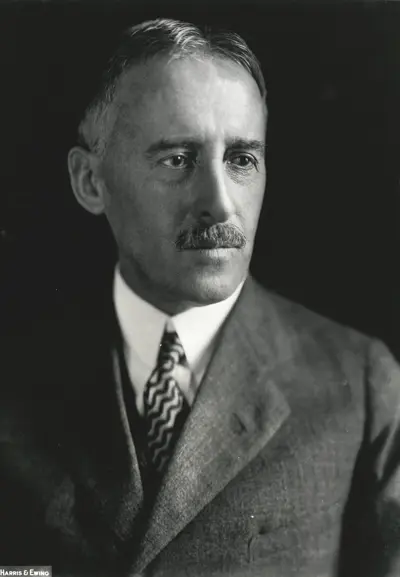
Henry Lewis Stimson was an American statesman, lawyer, and Republican Party politician. Over his long career, he emerged as a leading figure in U.S. foreign policy by serving in both Republican and Democratic administrations. He served as Secretary of War (1911–1913) under President William Howard Taft, Secretary of State (1929–1933) under President Herbert Hoover, and Secretary of War (1940–1945) under Presidents Franklin D. Roosevelt and Harry S. Truman.
