George B. McClellan Quotes
Not a regiment was properly encamped, not a single avenue of approach guarded. All was chaos, and the streets, hotels, and barrooms were filled with drunken officers and men absent from their regiments without leave—a perfect pandemonium.
George B. McClellan, 1826-1885, General-in-Chief of the Union Army, Democratic candidate for President, State of the Union Army of the Potomac when he assumed command, July 26, 1861
Sourced by: Eigen's Political and Historical Quotations

In the 1930s, led by the conservative Republicans, there was an isolationist subset of our population and the Congress that blocked all efforts to increase defense spending and readiness. The attitude towards the military was terrible. After WWII, the Republicans, realizing the weakness of their earlier political philosophy, flip flopped and went to the other extreme becoming hyper pro-military with little oversight of the needs.


What is interesting about this quote is that it is very much like many American politicians who support a large and strong military.

3rd Earl Russell of Kingston

FDR, Eleanor and lost liberals of the time were advocates of a strong military, and unlike after the 2nd Word War, most of the Republicans were conservative isolationists who were opposed to spending much public money for the armed services or weapons.


This amazing quotation was made in 2011 when he, President Xi Jinping, and some other senior Chinese leaders embarked on a reform program of the People’s Liberation Army which with decades of peace had grown soft and corruption was quite prevalent. See also {632517}.

Much of the Chinese military had been distracted from military readiness in favor of political, economic, and ceremonial, activity along with extensive economic corruption. The People’s Liberation Army is a major political force in China which made this a very noteworthy chastisement. Leading Generals were with him however. See {632518}.


He was referring to attacking the Barbary States. The Barbary Pirates had an incredible extortion racket going in the Mediterranean. If nations would pay them an annual sum each year, they would not attack and seize merchant ships of that country and sell the ships and goods while holding the sailors for ransom. See {640846}.


“Krauts” was a derogatory term for Germans. The American GIs loved Mauldin’s cartoons. However, much of the humor was directed at the Officers who were not as enthusiastic about the cartoons. The War Department didn’t agree with Patton and other officers who wanted the Mauldin Cartoons censored. They had determined that the cartoons were terrific for morale, and hence they printed them and distributed them to our troops the world over. See {629515} for Mauldin’s view of Patton.

Rush ran the hospitals for the Revolutionary Army and talked to many officers and enlisted men, and also observed much of the British military practices. These suggestions were discussed but never passed as regulations. They are fascinating insights into the problems of the general officers of the time who were generally selected for their socioeconomic status rather than other qualifications. Note the drunkenness limitation for a commanding general was proposed to be limited to only 1 allowed bout of drunkenness every 24 hours. It was, he thought, totally unrealistic to require generals to be always sober when on duty. With the mediocre quality of senior officers, Washington had to depend on foreigners like Lafayette, Von Steuben and others. And Generals who were leading attacks out in front of their men like Benedict Arnold immediately became heroes and one of the reasons he ended up as a traitor was that he thought that he was badly treated relative to the “society” Generals who would not accept him and denigrated his exploits when they themselves had never been close to a battle front.
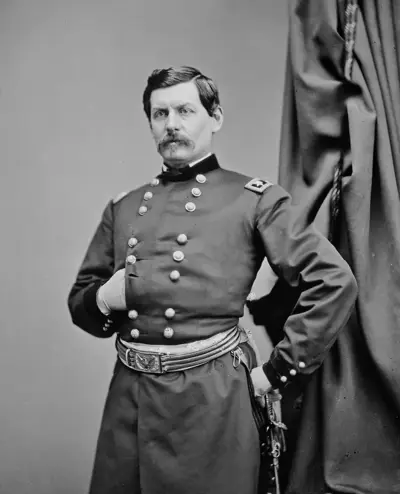
George Brinton McClellan was an American soldier, civil engineer, railroad executive, and politician who served as the 24th Governor of New Jersey. A graduate of West Point, McClellan served with distinction during the Mexican–American War (1846–1848), and later left the Army to work on railroads until the outbreak of the American Civil War (1861–1865). Early in the conflict, McClellan was appointed to the rank of major general and played an important role in raising a well-trained and organized army, which would become the Army of the Potomac in the Eastern Theater; he served a brief period (November 1861 to March 1862) as Commanding General of the United States Army of the Union Army.
