Joseph Cannon Quotes
No matter how great an improvement the new tariff may be, it almost always results in the party in power losing the election.
Advising against altering duty rates for imports:
Joseph Cannon, 1836-1926, U. S. Congressman (Republican, IL), Speaker of the House, Quoted in Busby, Uncle Joe Cannon
Sourced by: Eigen's Political and Historical Quotations


This historical quotation shows us that the nation under Republican control at the end of the 19th century was highly protectionist. In addition. It shows us how a party can flip flop on its most cherished principles. A century later, free trade was the cornerstone of Republican philosophy and opponents who held to the Republican 19th century principles were accused of being detriments to the American growth and economic system.

At the time, Republicans were the protectionists and Democrats were free traders—the reverse of the party roles at the end of the 20th century and the beginning of the 21st.

The issue of free trade has been controversial during the entire history of our Republic. At the time it was the Republicans who were the protectionists and the Democrats, the free traders.


The revenue laws he referred to were tariff duties on foreign imports that were instituted to protect fledgling American domestic manufacturers. The problem was that at the same time as it helped the manufacturers, it caused everyone to pay higher prices. Worse, it destroyed the business of the importers, and the retail merchants who specialized in fine European imports. It also hurt the shipping business so owners and sailors alike were damaged. Maritime and importing states were outraged and if enough people did not support the tariffs, smuggling would increase. Polarization and controversy were rife at the time. Unlike today conservatives tended to be for the protectionist tariffs and the left wing tended to be for free trade. Jackson insisted that the law be obeyed, but he wanted Congress to pay attention to the damaged forces.

The same problem has always existed with full scale trade wars always a possibility.


Note that in the beginning of the 20th century, the Democrats were the free traders opposing protectionism while the Republicans advocated strong protectionism to protect American companies. By the end of the 20th Century, both parties had flip flopped and taken the other’s position.

There has always been pressure from different interests to exempt certain products from duty and place higher duties on others. Calhoun urged a policy that would be based on general economic prinicples and conditions and not on pressure from special vested interests. He was a senator at the time.
Republicans at that time were adamant protectionists and were violently opposed to free trade. They made a total flip flop on free trade after the Second Word War when the industrial capacity of all of the major industrial nations except America was completely emaciated. America still had production and there was huge money to be made from being the only nation that could deliver goods to the world. Meanwhile Germany, France, England, and Italy, our largest competitors could hardly manufacture for their own needs and could not compete in the American market. So the American corporations then wanted to become free traders.

In addition the companies that are being protected suffer by not getting competitive and not utilizing the most modern and most efficient techniques. Even construction workers are hurt as protected companies do not modernize their facilities as often and build new plants.

1st Earl of Beaconsfield
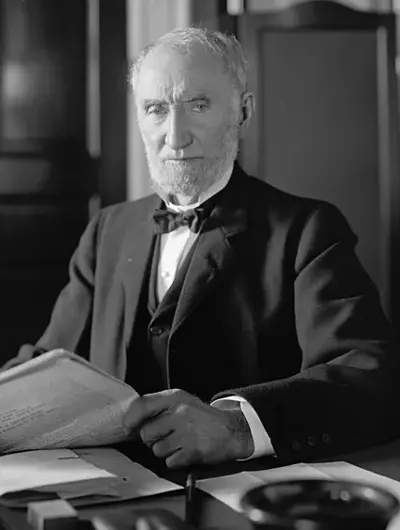
Joseph Gurney Cannon was a United States politician from Illinois and leader of the Republican Party. Cannon served as Speaker of the United States House of Representatives from 1903 to 1911, and many consider him to be the most dominant Speaker in United States history, with such control over the House that he could often control debate. The Cannon House Office Building, the oldest congressional office building, completed in 1908, was named for him in 1962.
