Alexis de Tocqueville Quotes
Muhammad professed to derive from Heaven, and he has inserted in the Koran, not only a body of religious doctrines, but political maxims, civil and criminal laws, and theories of science. The gospel, on the contrary, only speaks of the general relations of men to God and to each other - beyond which it inculcates and imposes no point of faith. This alone, besides a thousand other reasons, would suffice to prove that the former of these religions will never long predominate in a cultivated and democratic age, whilst the latter is destined to retain its sway at these as at all other periods.
Tocqueville, Alexis de. Democracy in America. Translated by Henry Reeve, vol. 2, Saunders and Otley, 1840, p. 45.


Egyptian law prohibits anyone from assaulting anyone else. Under this provision for example a man who has beaten his wife senseless, has not committed a crime if he was disciplining his wife which is allowed under Islamic law. This Article allows Egypt to pass all kinds of modern laws, none of which will apply if the transgressor claims his rights under Islam.
Theological & Legal Expert. The Sunnah, like the Koran, has statements of the Prophet, Mohammad. A fatwa is a religious legal ruling. This particular Fatwa shows the great difference between the Islamic State and a Republic or Democracy. In the latter forms, any religious practices must be consistent with the Constitution. Even though blasphemy might be prohibited by a religion, the United States Constitution for example protects anyone’s right to be blasphemous. In the Islamic system any constitution or law is subservient to and must be consistent with, the sayings of the Prophet Muhammad. In that sense, unless the Muslim populated nation is secular like Turkey, then the governments are partial or total theocracies.
The last Caliph of the Muslims was removed in 1924 as part of the Turkish Reform. The position has had attraction for many Muslim leaders who saw themselves in the role, but since 1924, nationalism and modernism and the lack of an effective international Muslim leader has precluded it. This anti-revolutionary sentiment of the Islamic political state that is so traditional, may in part account for the Islamic tolerance of autocratic regimes. Note that the distinction between religious responsibilities and civil are important. Tyranny must be tolerated but not blasphemy or heresy. Traditional Muslims provide more tolerance and forbearance for a leader’s civil failings than religious. But Muslims were not the only people to do this. A British prime minister had a view with the same conservative logic. See {639130}. The ancient Jewish Macabean revolt against the Jewish king was all based on failure to perform required religious duties of sacrifice as opposed to tyranny and poor government which also existed. Popes excommunicated Kings for religious reasons, not because of their civil failures at governing. Holding rulers accountable for civil performance is a relatively new concept yet is indispensible in a modern democracy.

This is one of the early calls for a partition of India which was to be so disastrous after the Second World War. The “free Muslim state of states” turned out to be Pakistan where they have been fighting amongst themselves about how much Sharia would prevail.

This quotation illustrates the difficulty when a jurisdiction adopts an established religion. From a freedom point of view, it is bad that Hamas insisted on all these rules for Muslims, but when they insist that Christians (and others) follow them as well, it becomes very difficult to have a harmonious society.


They are so different that most people in the West think of what Khamenei describes as “religious democracy” as not even close to democracy—almost the antithesis of democracy, and Islamic fundamentalists perceive Western democracy as sinful and evil.


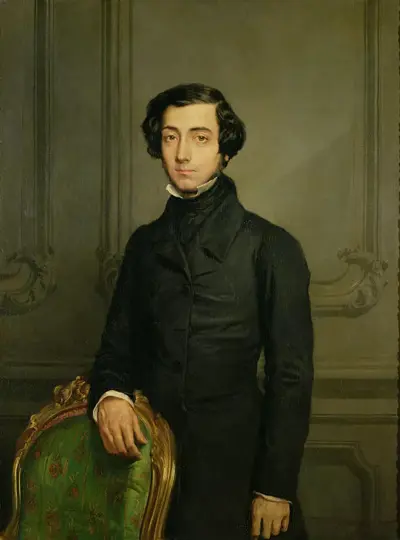
Alexis Charles Henri Clérel, comte de Tocqueville, colloquially known as Tocqueville (/ˈtɒkvɪl, ˈtoʊk-/), was a French aristocrat, diplomat, political scientist, political philosopher and historian. He is best known for his works Democracy in America (appearing in two volumes, 1835 and 1840) and The Old Regime and the Revolution (1856). In both, he analysed the improved living standards and social conditions of individuals as well as their relationship to the market and state in Western societies. Democracy in America was published after Tocqueville's travels in the United States and is today considered an early work of sociology and political science.
