Matteo Salvini Quotes
With Islam, there's the Sharia. There's the Islamic law which prevails, and as long as it doesn't distinguish between God and the state, it's a problem.
"Salvini links Islam, Sharia and violence." ANSA, Agenzia Nazionale Stampa Associata, 18 Jan. 2015.

Theological & Legal Expert. The Sunnah, like the Koran, has statements of the Prophet, Mohammad. A fatwa is a religious legal ruling. This particular Fatwa shows the great difference between the Islamic State and a Republic or Democracy. In the latter forms, any religious practices must be consistent with the Constitution. Even though blasphemy might be prohibited by a religion, the United States Constitution for example protects anyone’s right to be blasphemous. In the Islamic system any constitution or law is subservient to and must be consistent with, the sayings of the Prophet Muhammad. In that sense, unless the Muslim populated nation is secular like Turkey, then the governments are partial or total theocracies.

This is a very important point as most Muslims believe that the actual wording of the Sharia—Islamic Law—comes from the Prophet directly and are not the words of various legal scholars which is just what they are. Needless to say, there are many differences and even contradictions depending on time and the particular scholar. Islam however has no authority that religiously is higher than any other. In that respect, it is like Judaism. There is not a recognized religious hierarchy as there is in Christian churches.


Gabriel exaggerates in the sense that while the quotation is correct for many Muslims, it is by no means true of all. Iran for example is an Islamic theocracy, but Turkey is a 99 percent Muslim nation which is totally secular and in some ways is much more restrictive of Islamic teaching and practice than most secular democracies. The fundamentalist Muslim view of the state and religion is essentially the same as the ultra orthodox Jews and Christians. It is true that a greater proportion of Muslims believe in the merging of civil and religious law than Jews and Christians, but by no means all. The non Arab Muslims are much less likely to see the unity of state and religion.

The letter had been written earlier, but this and 51 other letters written when she was in Turkey were published in 1763. At the time, Turkey, the seat of the Ottoman Empire, was an Islamic state operating under Islamic law, as were all countries within the Ottoman Empire. Today, Turkey is a secular state and the clergy and the legal profession are separate.

The doctor argues that the problem of public health in the Islamic world is in large part due to the fact that health care is not organized any more under the control and governance of an Islamic institution—one which is guided by the Koran and Islamic tradition. Other physicians and public health experts believe one central obstacle to public health in Muslim nations is the strong influence that the Mullahs have over the behavior of the population and the medical and health practices that are acceptable and desirable to them are those of the Arabian Desert of the 7th Century or in some more modern interpretations, the medicine of the Islamic world of the 12th century when Islamic Medicine was the best in the World.


The notion that Islam would be practiced by individuals was in the Ayatollah’s view insufficient. Islam must also control the government—the head.

Although Sharia specifies the death penalty for homosexuality, the practice appears to be as frequent in Islamic society as in the West. Although the penalty is very harsh, Sharia requires FOUR witnesses to the acts. This makes it almost impossible to convict two homosexuals.

This is one of the early calls for a partition of India which was to be so disastrous after the Second World War. The “free Muslim state of states” turned out to be Pakistan where they have been fighting amongst themselves about how much Sharia would prevail.


They are so different that most people in the West think of what Khamenei describes as “religious democracy” as not even close to democracy—almost the antithesis of democracy, and Islamic fundamentalists perceive Western democracy as sinful and evil.

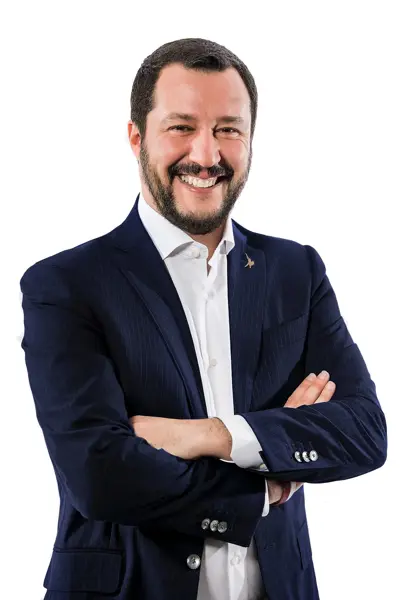
Matteo Salvini is an Italian politician who served as Deputy Prime Minister of Italy and Minister of the Interior from 1 June 2018 to 5 September 2019. He has also been Federal Secretary of the Northern League since December 2013. He has been a Senator in the Italian Senate since March 2018. He previously served as a Member of the European Parliament (MEP) for the constituency of North-West Italy from 2004 to 2018.
