Tariq Ramadan Quotes
In Islam, rules are important, like the Prophet said innal halaala bayyinun, wa innal haraama bayyinun ["what is halal is clear, what is haram is clear"]. The goal is not to diminish the importance of rules, but to have the right priorities.
Ramadan, Tariq. Radical Reform: Islamic Ethics and Liberation. Oxford University Press, 2009.

Theological & Legal Expert. The Sunnah, like the Koran, has statements of the Prophet, Mohammad. A fatwa is a religious legal ruling. This particular Fatwa shows the great difference between the Islamic State and a Republic or Democracy. In the latter forms, any religious practices must be consistent with the Constitution. Even though blasphemy might be prohibited by a religion, the United States Constitution for example protects anyone’s right to be blasphemous. In the Islamic system any constitution or law is subservient to and must be consistent with, the sayings of the Prophet Muhammad. In that sense, unless the Muslim populated nation is secular like Turkey, then the governments are partial or total theocracies.


He confuses modernity and religion. Muslims who live in a modern world have the same degree of bureaucracy then the Christians, Jews, Hindus, Buddhists and other religions do. The Muslims of America have the same degree of paperwork as other Americans, and the Turkish bureaucracy has as much filing and other paperwork as countries where the majority of people are of different religions. Historically, when England and France and other Christian countries were in the Dark Ages, Islamic bureaucrats kept Western and Eastern knowledge alive, and when the Ottoman Empire ruled most of the known world, they almost collapsed under their very heavy bureaucracy.
This is a very important point as most Muslims believe that the actual wording of the Sharia—Islamic Law—comes from the Prophet directly and are not the words of various legal scholars which is just what they are. Needless to say, there are many differences and even contradictions depending on time and the particular scholar. Islam however has no authority that religiously is higher than any other. In that respect, it is like Judaism. There is not a recognized religious hierarchy as there is in Christian churches.
This is not terribly different however from Christians and Jews selectively quoting the Bible.


The doctor argues that the problem of public health in the Islamic world is in large part due to the fact that health care is not organized any more under the control and governance of an Islamic institution—one which is guided by the Koran and Islamic tradition. Other physicians and public health experts believe one central obstacle to public health in Muslim nations is the strong influence that the Mullahs have over the behavior of the population and the medical and health practices that are acceptable and desirable to them are those of the Arabian Desert of the 7th Century or in some more modern interpretations, the medicine of the Islamic world of the 12th century when Islamic Medicine was the best in the World.

Perhaps this quotation gives the best insight to the major difference between an Islamic perspective of law and the Western. The latter places the rights of the individual on a par with or even superior to that of the society as a whole. The former is more concerned with the effect and result on society as a whole than concern with the individual rights of single individuals.
Muslims are divided about the role of the Islamic religious courts. Some believed that these should be the only courts and should govern all law, religious and civil on the grounds that there are no real differences in Islam. Others believe, as Jammal put forth, that religious courts should only deal with religious and personal matters. Still others believe that these is no place in modern society for religious courts. This debate echoes the debate that took place in Christianity and Judaism, but the vast majority of these have concluded that there is no place for religious courts
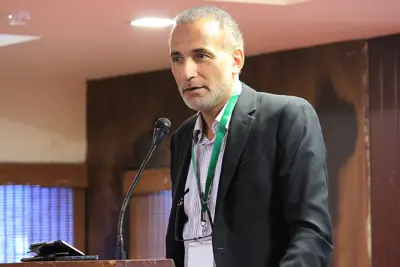
Tariq Ramadan is a Swiss Muslim academic, philosopher, and writer. He was a professor of contemporary Islamic studies at St Antony's College, Oxford and the Faculty of Theology and Religion, University of Oxford, but as of 2018 is taking an agreed leave of absence. He is a visiting professor at the Faculty of Islamic Studies at Hamad Bin Khalifa University in Qatar, and the Université Mundiapolis in Morocco. He is also a senior research fellow at Doshisha University in Japan. He is the director of the Research Centre of Islamic Legislation and Ethics (CILE), based in Doha. He is a member of the UK Foreign Office Advisory Group on Freedom of Religion or Belief. He was elected by Time magazine in 2000 as one of the seven religious innovators of the 21st century and in 2004 as one of the 100 most influential people in the world and by Foreign Policy readers (2005, 2006, 2008–2010, 2012–2015) as one of the top 100 most influential thinkers in the world and Global Thinkers. Ramadan describes himself as a "Salafi reformist".
