French Assembly Quotes
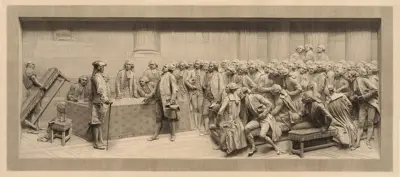
Members of this Assembly shall immediately take a solemn oath not to separate, and to reassemble wherever circumstances require, until the constitution of the kingdom is established and consolidated upon firm foundations; and that, the said oath taken, all members and each one of them individually shall ratify this steadfast resolution by signature.
Sometimes called the “Tennis Court Oath.” (See {587555}.) The deputies (legislators) had been locked out of their usual chamber by the king and so they met nearby in an indoor tennis court (actually a handball court). They took an oath to work together for a Constitution for France. This was the first assertion of revolutionary authority by the Third Estate (the nobility was the 1st, the clergy the 2nd and the people—97% the Third Estate) and it united virtually all its members to common action.
French Assembly, Oath, June 20, 1789
Sourced by: Eigen's Political and Historical Quotations

This oath was required of Southern Rebels who wanted obtain amnesty from treason which they had committed by engaging in the Civil War. See {623307} for the Presidential Proclamation.

The Emperor had made his brother King of Holland, thinking of it as an unimportant backwater of the French Empire. But Louis took his oath and job very seriously, and although he did not have the great talent of his brother, he made a serious effort to be a good king.


William V, Prince of Orange, was a very hapless monarch of Holland who was ineffective in dealing with revolutionary discontent despite help and support of England. The King of England was resigned to Holland becoming, like France, a Republic. The English statesmen and diplomats, while aiding William, were also secretly providing money and other assistance to the Patriot rebels, to ensure good relations with the Dutch republican leaders.
the Dutch monarchy supported by England The French fear of course was that the revolutionary fervor spreading to the bourgeois could easily spread to France, and that is exactly what happened 4 years later. See {639769} for more of his view on the Dutch revolutionary spirit that might infect France.

The members of the Ribbon Society were referred to as Ribbonists and they saw themselves as a counterweight to the Orange Order of the extremist Protestants. The Protestants were the “Hereticks”—this was the spelling of the time.

We have come to Paris He had come to Paris with his pupil Wilhelm von Humboldt to personally witness what he regarded as a great event in the history of mankind.

Ironically, just before the bloody French Revolution, there was a substantial movement in France to abolish the death penalty. But the revolution triggered a reign of terror that was shocking to all of Europe then and in the future.
Many people think that the French Revolution was spontaneous. Some events at the beginning were, but de Gouges and other political observers cold see that disaster was looming.


The Fascist Dictator hinted at all the Church property that the State might seize and began to place taxes on the Church and in a brilliant political stroke actually negotiated the Lateran Pacts of 1929 with the Church whereby the Dictator would guarantee all the churches property and protect its officials end exempt the church from taxation and all the Church had to do was have all their Italian Bishops swear to this oath of political support for the dictatorial fascist state and its outrages and aggression and denial of rights. He actually have the church more religious power than they had enjoyed in Italy for years. For example he turned over the public school curriculum to the church with no other religion considered. Despite thus oath of the Italian bishops, there were a number of individual Catholic priests who aided the anti-Fascist resistance, but for the most part Mussolini bought the political and moral support of the Catholic Church. Apologists for the Church at the time point out that the entire Vatican and the Pope was totally within the dictator’s span of control, and he could jail any of the Holy see who criticized him or have them executed as he did so many others. He could also loot the Vatican and sell off holy relics and other object to finance his wars of aggression and his alliance with Hitler. They argue that there was nothing any priests could say that would break the iron hold Mussolini had on Italy and at least, the priests could perform their pastoral functions so long as they supported the Fascists. The debate continues to this day. However, after WWII Italians left the Catholic Church in droves and it is one of the least religious states in Europe.