Sir Frederick Pollock, 3rd Baronet Quotes
Medieval justice was a quaint thing.
Howe, Mark DeWolfe, ed. Holmes-Pollock Letters: The Correspondence of Mr. Justice Holmes and Sir Frederick Pollock, 1874-1932. Harvard University Press, 1941.


This required much of the population to maintain and bear arms. Another part of the law required the arms-bearers to be at the service of the king and as such was the king's militia.

The code provided for trial by jury and for proportional taxation on property. It was called “The Duke’s Laws” in recognition of the English Duke of York from whom authority in the colony then derived as the English supplanted the Dutch.

A fief was an estate of land and people. The man who had the title to the fief was obligated to raise troops from his estates and lead then at the command of the King. Women, under English law could not inherit a fief—it went to the oldest son. However, once the military element of fiefdom was eliminated, Johnson saw no reason why women should no longer inherit feifs and the titles that went with them.


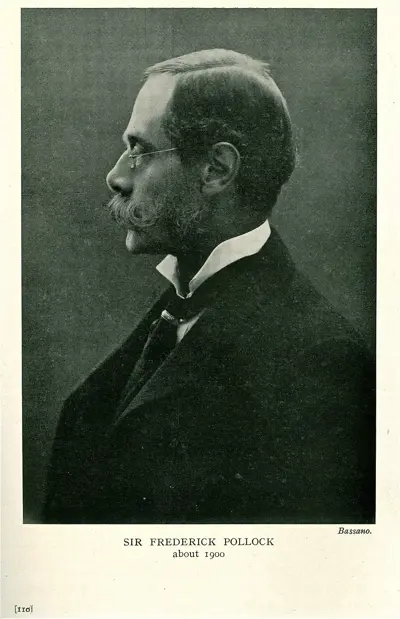
Sir Frederick Pollock, 3rd Baronet PC, FBA was an English jurist best known for his History of English Law before the Time of Edward I, written with F.W. Maitland, and his lifelong correspondence with US Supreme Court Justice Oliver Wendell Holmes. He was a Cambridge Apostle.
