New York Times Quotes
Lincoln owes a higher duty to the country…than to fritter away the priceless opportunities of the Presidency in listening to the appeals of competing office—hunters.
Lincoln saw all office seekers personally
New York Times, April 4, 1861
Sourced by: Eigen's Political and Historical Quotations


Later, Eisenhower changed his mind and ran for the Republican Presidential Nomination. Truman, who had always been a strong Eisenhower enthusiast, felt that Eisenhower had lied to him and was distrustful of the General ever after.

Upon learning that his son, John Quincy Adams, had been chosen President of the United States, the former President remarked:


Seward had been the odds on favorite to win the Republican Presidential nomination and was totally surprised when he did not and Lincoln did. Seward was one of the most prominent politicians in the nation while Lincoln was a relative unknown who had served a single non descript term in the House of Representatives. However, there were other prominent Republicans contesting for the nomination. Lincoln’s team followed a strategy of trying to be the second choice of many of the delegations who favored another candidate. When none of the front runners could muster a majority, delegations started shifting to their second choices and that’s when Lincoln ended up with the majority beating his better known opponents.

Note that early constitutional experts assumed that one of the President’s roles was to be non partisan and control partisanship. Note the phrase ‘prevent the artifices of party’. The early founders were very wary of political parties of ‘factions’ as Madison called them. However, most were extremely partisan although in the Presidency partisanship was toned down by George Washington but after him, partisan ship became the norm.


America’s first political economist. This is a wonderful quotation which shows the compromises that even a great president like Abraham Lincoln had to act when Congress passed must have bills.

He was reacting to President Donald Trump's demands of Personal Loyalty of his appointees. Trump was a businessman who ran provate (not public) corporations where it was not unusual for the owner to demand personal loyalty of all his key employees. He had not historical knowledge of experience with public service in America where, unlike campaigns, all officials take an oath of loalty to the Constitution and the nation and not to the President. Trump had fired the then FBI Director who was investigationg his campaign for illegal contacts with the Russians, which Trump regarded as an act of disloyalty, especially when the Director refused to pledge his loyalty to Trump.


_0_PostageStamp_47x47.jpg "Chairman of the Joint Chiefs of Staff Navy Adm. Mike Mullen gives an interview to John Dickerson during the CBS news program Face the Nation in Washington, D.C., July 5, 2009. During the interview, Mullen discussed the wars in Iraq and Afghanistan, North Korea's recent missile tests and his recent visit to Russia. (DoD photo by Mass Communication Specialist 1st Class Chad J. McNeeley, U.S. Navy/Released)")

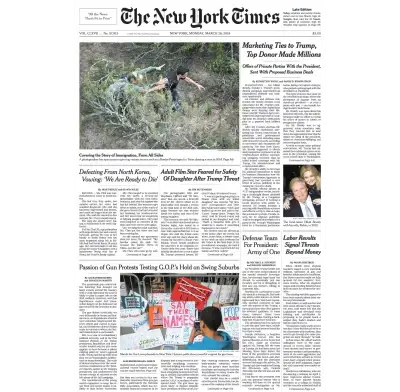
The New York Times (NYT or NY Times) is an American daily newspaper based in New York City with a worldwide readership. Founded in 1851, the Times has since won 130 Pulitzer Prizes (the most of any newspaper), and has long been regarded within the industry as a national "newspaper of record". It is ranked 18th in the world by circulation and 3rd in the U.S.
