Rutherford B. Hayes Quotes
[It is the] duty of the United States to assert and maintain such supervision and authority over any inter-oceanic canal across the isthmus that connects North and South America as will protect our national interest.
Theodore Roosevelt was not the first President to be concerned with American control of a canal across South or Central America. Control was a political issue before there even was a canal.
Rutherford B. Hayes, 1822-1893, 19th President of the United States (Republican, OH), Quoted by his successor, James A. Garfield in his Inaugural Address, March 4, 1881
Sourced by: Eigen's Political and Historical Quotations


Bell was an American who worked for the London Times.

His dream was for a conference of South and Central American leaders who would meet with other world leaders to maintain peace and eliminate war. This was one of the early visions of a League of Nations or a United Nations.

Muslim clerics usually have little education beyond their study of the Koran and other holy books. Unlike most Western clerics who are college graduates, they often have little non-religious sophistication. This quotation is a great example of this. Al-Bouti, interviewed on Syrian TV accuses the United States of something that almost all basic students of political science and international relations know is true of every country including his own. However, the fundamentalist Muslim is supposed to be governed in all things by only one thing—the word of Allah as revealed by His Prophet Muhammad. So he believes that good, moral nations—especially Islamic ones will view the entire world, not through the lens of self interest but through the Koran. Syria, in particular, is one of the most selfish and least moral nations in its diplomacy and foreign policy and much of its activity would even be considered morally wrong by most moderate Islamic clergy.


The French had a plan to construct a canal across Panama.


The Treaty with Spain ending the Spanish American War was up for Senate Ratification. But the treaty gave the Philippines to the United States, and anti-imperialist Senators balking at ratifying the Treaty.


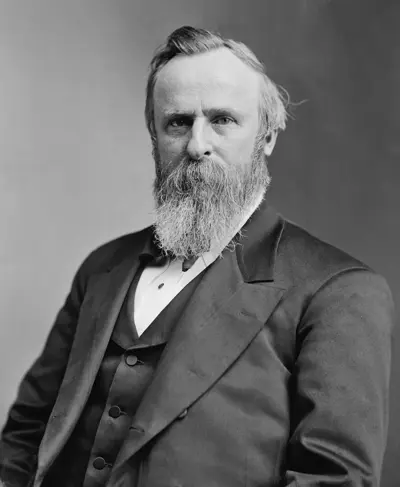
Rutherford Birchard Hayes was an American politician and attorney who served as the 19th president of the United States from 1877 to 1881, after serving in the U.S. House of Representatives and as governor of Ohio. A lawyer and staunch abolitionist, he had defended refugee slaves in court proceedings during the antebellum years. He negotiated the political agreement to end federal support of Reconstruction.
