Tariq Ramadan Quotes
It is of the highest importance to provide equal access to the labour market. Governments should act to establish equitable employment standards and penalise racial discrimination.
Ramadan, Tariq. Western Muslims and the Future of Islam. Oxford UP, 2004.


The function of government is to


In this case she provided the crucial 5th vote for the majority upholding racial preferences in affirmative action cases.

He was the first FHA administrator to make statements saying that non-discriminatory housing services should be available to the American people. He was not able to change the agency’s equal opportunity performance because the Southern states had laws allowing and protecting legal segregation especially in housing. The Southern staff interpreted his position to be sure that both blacks and whites had access to FHA services, but they used the “separate but equal” doctrine: Provide services to both races but always in segregated housing projects. This was typical of the kinds of problems that motivated the Civil Rights Acts offered by President Kennedy in 1963 and passed by President Johnson in 1964 See {637271} for a similar Mason statement.

The decision was 5-4 and reversed a trend in which the court had been going before. Roberts and another appointment by George W. Bush tilted the majority. See {614911} for a quotation from the 4 justice dissent.

Subsection (1) states that all Canadians are equal. Canada built affirmative action into its most recent constitution.

When the Democrats won the presidency, there was great fear that all the appointments that Blacks had garnered would be undone as the results of the Southern racist element of the Democratic party. The President held the line, much to the distress of his Southern supporters.


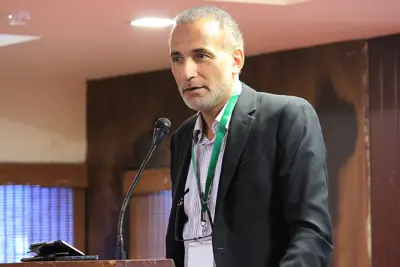
Tariq Ramadan is a Swiss Muslim academic, philosopher, and writer. He was a professor of contemporary Islamic studies at St Antony's College, Oxford and the Faculty of Theology and Religion, University of Oxford, but as of 2018 is taking an agreed leave of absence. He is a visiting professor at the Faculty of Islamic Studies at Hamad Bin Khalifa University in Qatar, and the Université Mundiapolis in Morocco. He is also a senior research fellow at Doshisha University in Japan. He is the director of the Research Centre of Islamic Legislation and Ethics (CILE), based in Doha. He is a member of the UK Foreign Office Advisory Group on Freedom of Religion or Belief. He was elected by Time magazine in 2000 as one of the seven religious innovators of the 21st century and in 2004 as one of the 100 most influential people in the world and by Foreign Policy readers (2005, 2006, 2008–2010, 2012–2015) as one of the top 100 most influential thinkers in the world and Global Thinkers. Ramadan describes himself as a "Salafi reformist".
