Henry A. Kissinger Quotes
It is inevitable that Japan will emerge as a major military power in the not too distant future.
At the insistence of America at the end of WWII, the Japanese Constitution prohibits an army, navy or other military force. However, there are right wingers in Japan who are urging a change in the Constitution so Japan can take its “rightful” place.
Henry A. Kissinger, U.S. Secretary of State (Republican), U.S. National Security Advisor, 1987
Sourced by: Eigen's Political and Historical Quotations

It is hard for us to envision that sophisticated and intelligent men like Sherman would actually see Communism as a danger of defeating capitalism. Our intelligence was poor and often exaggerated to justify military buildups and much of the leadership made statements like this and then many began to believe their own propaganda. Ironically, those who knew communism the best were more aware and realistic of the fatal flaws in not only communism in general but in the particular Soviet repressive version of communism. It would take almost 50 years, but the Soviet Union collapsed revealing its weaknesses for all to see.


Greek invaders were marching on Istanbul


This size standing army which alarmed so many at the beginning of the 20th century, looked very small when compared with the standing army of America a century later. For earlier American Politician’s views on a standing army, see {592824}, {631687}, {622888}, and {641008}.

He wrote this essay anonymously and signed it as “A Lover Of Peace”


This quotation illustrates some of the interesting attitudes of early Americans. First, note the backhanded slap at a standing army. The navy was much preferred by early Americans as history had demonstrated that most republics had been destroyed by their own armies taking over in some “emergency” of time of “crisis.” This also helps explain why the army and navy were different departments of government—a tradition that lasted until after WWII. The two departments had totally different purposes and objectives and presented different potential dangers to the nation.


At that time there were extensive meetings and discussions for the creation of what was to be the United Nations. The negative view of the United Nations or other international security organization is now and always has been held by a vocal minority in the United States.


This was written when the United States was not a dominant military power. At the beginning of the 20th century, the U. S. had the same size military as Argentina. It was France, German, Turkey and England who had the military superiority and it was they who tended to find excuses for war. After WWII, the U. S. was dominant and was involved with a number of wars and military incursions, often with nations that had not attacked the U.S. Korns’ principle was most dramatic when the George W. Bush administration invaded Iraq on the excuse that the Iraqis were developing weapons of mass destructions and then might attack the United States. After the successful invasion, the excuse was shown to be hollow as there were no signs of sophisticated weapons development.


Since the Partition of India to create the state of Pakistan, Pakistan has wanted to integrate the Muslims—especially near the border. However, many Indian Muslims did not choose to leave India for the new Islamic nation. Pakistan has had designs on some of the Indian areas and has maintained a very large army.

That was an ironic statement. Shortly thereafter we invaded Mexico, occupied the country, pressured it into “selling us much of what is now the Southwest of the United States, and finally left.

He was exactly right. See {642079} for a perfect example of this prediction.


The notion of America flexing its military muscles and intimidating other nations by sending a fleet of 16 battle ships around the world was not greeted enthusiastically by some. However in Japan, the reaction was totally positive. The Russo-Japanese War had been ended thanks to the mediation of Theodore Roosevelt (for which he was awarded the Nobel Peace Prize) and America was a model for much of Japan’s modernization. 25 years later the Japanese would view America as an interfering, intimidating bully, curtailing their national aspirations and rights.
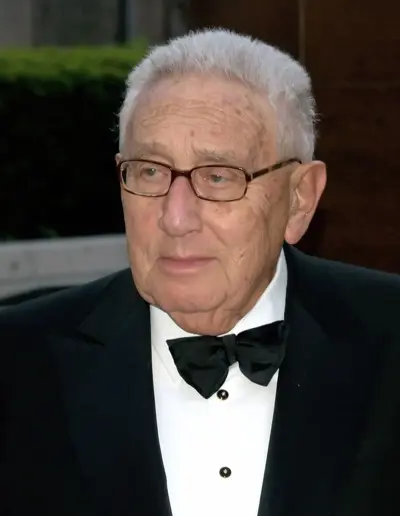
Henry Alfred Kissinger KCMG is an American politician, diplomat, and geopolitical consultant who served as United States Secretary of State and National Security Advisor under the presidential administrations of Richard Nixon and Gerald Ford. A Jewish refugee who fled Nazi Germany with his family in 1938, he became National Security Advisor in 1969 and U.S. Secretary of State in 1973. For his actions negotiating a ceasefire in Vietnam, Kissinger received the 1973 Nobel Peace Prize under controversial circumstances, with two members of the committee resigning in protest.
