Noam Chomsky Quotes
Israel is following policies which maximise its security threats... policies which choose expansion over security... policies which lead to their moral degradation, their isolation, their delegitimation, as they call it now, and very likely ultimate destruction. That's not impossible.
Chomsky, Noam. "Noam Chomsky: The Israel-Palestine Conflict." Al Jazeera, 10 Aug. 2012.


The Byzantine emissary had pointed out that Mehmed’s predecessors had signed a treaty agreeing to “consult” with Constantinople before building any fortified structure in the area surrounding Constantinople. Mehmed was only 19 years old at this time. His intention f building a fort was to have a platform from which to attack and capture Constantinople itself which he did 2 years later. Earlier, the Eastern Roman Empire was much stronger and the Ottoman sultans were more cautious in dealing with them. However, the various Christian factions were all feuding with each other, and Mehmed II, despite his youth, was much better organized and was a better leader than his predecessors.

This amazing quotation was made in 2011 when he, President Xi Jinping, and some other senior Chinese leaders embarked on a reform program of the People’s Liberation Army which with decades of peace had grown soft and corruption was quite prevalent. See also {632517}.

This size standing army which alarmed so many at the beginning of the 20th century, looked very small when compared with the standing army of America a century later. For earlier American Politician’s views on a standing army, see {592824}, {631687}, {622888}, and {641008}.

The final decision regarding the attack on Pearl Harbor and war with America had to be made. The Emperor Hirohito, Prime Minister Tojo, the full cabinet and leading elder statesmen were invited. Hara attended as one of the latter class. America had instituted an embargo of critical raw material whose end was contingent of Japan withdrawing from the territory that they had invaded and stop their territorial aggression in Asia, an aggression which some Japanese leaders—notably the military—was absolutely necessary to provide for the growing Japanese population and its increasing standard of living. At the time, an embargo was a powerfully effective weapon, which left Japan only two choices: Withdrawal or War. In modern times nations have chosen to endure and evade embargoes rather than be forced into undesirable positions.

In early WWII, he opposed the Japanese military practice of killing conquered civilian people to instill fear and make them accept occupation. (In this case in occupied Indonesia). He was arrested by the military and sentenced to death, but he never was executed. Though not generally known, there were a number of Japanese who opposed the Japanese military policies and practices. He was one.

This quotation is a good illustration of a practice that existed in the age of Empire where two or more large powers would agree among themselves as to which one of them had the right to seize a smaller power, not part of the compact.

Jefferson had insisted that the expedition was purely scientific. The fact that it was lead by two military officers and involved soldiers led many to suspect the expedition was an “invasion” of what was then officially Spanish Territory. The very small size of the expedition made the concept of an expansion effort seemingly ridiculous to many. Jefferson was never public about his hopes fort the eventual possibilities but Martinez seemed to have gotten it right but was paid little heed.

In retrospect Marshall was prescient and if his advice had been followed, the country would have been much better off at the beginning of WWII. The nation was isolated politically and militarily with Republicans and southern Democrats often opposing President Roosevelt’s attempts to help them defend themselves. There was of yet no political will for military preparedness.


America had declared war on Mexico and President Polk had designs on California and other territory.
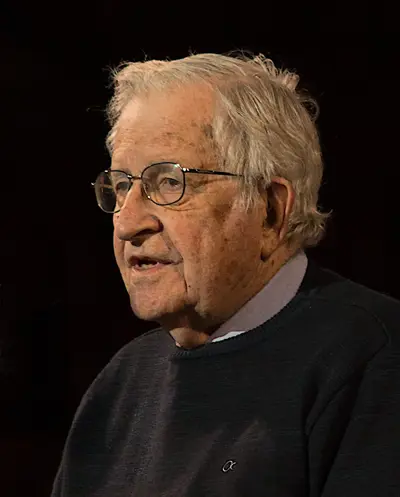
Avram Noam Chomsky is an American linguist, philosopher, cognitive scientist, historian, social critic, and political activist. Sometimes called "the father of modern linguistics", Chomsky is also a major figure in analytic philosophy and one of the founders of the field of cognitive science. He is Laureate Professor of Linguistics at the University of Arizona and Institute Professor Emeritus at the Massachusetts Institute of Technology (MIT), and is the author of more than 150 books on topics such as linguistics, war, politics, and mass media. Ideologically, he aligns with anarcho-syndicalism and libertarian socialism.
