George C. Marshall Quotes
Dictator governments are arming heavily and penetrating economically and politically in Central and South America. Japan is establishing a "new order" in China and has been informed that we will have something to say about this "new order." These activities emphasize the possibility of this nation becoming involved in war in the Atlantic, in the Pacific, or in both these areas
In retrospect Marshall was prescient and if his advice had been followed, the country would have been much better off at the beginning of WWII. The nation was isolated politically and militarily with Republicans and southern Democrats often opposing President Roosevelt’s attempts to help them defend themselves. There was of yet no political will for military preparedness.
George C. Marshall, 1880-1959, General & U. S. Army Chief of Staff, U. S. Secretary of State, U. S. Secretary of Defense, Nobel Peace Prize Winner (The only soldier ever so honored), Quoted in WPD Memo Feb 1939
Sourced by: Eigen's Political and Historical Quotations

Unusually for a scientist, Szilard was politically very astute. In this letter he predicted exactly what was going to happen in Europe which would be WWII. He was the leading scientist organizing the lobbying efforts with the Franklin D. Roosevelt administration to develop an atomic bomb.


Everyone could see the First World War coming, but the government leaders and diplomats were not able to prevent it.
Trieste was occupied by the British and Americans theoretically, but Tito’s Yugoslavian troops had done most of the WWII fighting and dying in the area and wanted control for the Russian Allies of which Tito was then one. There were frequent armed standoff’s of Anglo Americans and Yugoslav troops that could easily have evolved to full scale fighting. Nine months later, Tito broke with Stalin. An interesting historical fact is that Richard M. Nixon was one of the Congressional Delegation then visiting Trieste.

America, England, Germany and France Many Japanese leaders predicted war between the Great Powers while America and its European Allies did not see the danger as clearly. Shortly after 1936, Hitler began the Second World War. Japan was indeed prepared. Hiranuma became one of the Japanese extremists and after WWII was convicted of war crimes and given a life sentence.


He wrote this essay anonymously and signed it as “A Lover Of Peace”


Referring to President Woodrow Wilson's signing of the Treaty of Versailles and the League of Nations:
This was written when the United States was not a dominant military power. At the beginning of the 20th century, the U. S. had the same size military as Argentina. It was France, German, Turkey and England who had the military superiority and it was they who tended to find excuses for war. After WWII, the U. S. was dominant and was involved with a number of wars and military incursions, often with nations that had not attacked the U.S. Korns’ principle was most dramatic when the George W. Bush administration invaded Iraq on the excuse that the Iraqis were developing weapons of mass destructions and then might attack the United States. After the successful invasion, the excuse was shown to be hollow as there were no signs of sophisticated weapons development.


Hobson, like Mark Twain in America, was a major critic of imperialism.


In both the First and Second World Wars the Western nations had a multilateral defense pact which did little good in the face of German aggression.


The U. S. and Russia


Peruvian Revolutionary Group. This speech was made from prison.
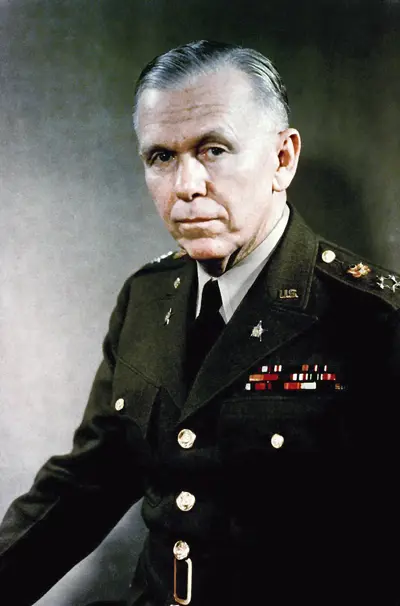
George Catlett Marshall Jr. was an American soldier and statesman. He rose through the United States Army to become Chief of Staff under presidents Franklin D. Roosevelt and Harry S. Truman, then served as Secretary of State and Secretary of Defense under Truman. Winston Churchill lauded Marshall as the "organizer of victory" for his leadership of the Allied victory in World War II. After the war, he spent a frustrating year trying and failing to avoid the impending civil war in China. As Secretary of State, Marshall advocated a U.S. economic and political commitment to post-war European recovery, including the Marshall Plan that bore his name. In recognition of this work, he was awarded the Nobel Peace Prize in 1953.
