Leo Szilard Quotes
It is quite probable that Germany will rearm and I do not believe this will be stopped by intervention of other powers within the next years. Therefore it is likely in a few years to have two heavily armed antagonistic groups in Europe, and the consequence is that we shall get war …
Unusually for a scientist, Szilard was politically very astute. In this letter he predicted exactly what was going to happen in Europe which would be WWII. He was the leading scientist organizing the lobbying efforts with the Franklin D. Roosevelt administration to develop an atomic bomb.
Leo Szilard, 1898-1964, Hungarian-American Nuclear Scientist, Letter to a friend in the early 1930s Quoted in Richard Rhodes, The Making of the Atomic Bomb, 1986
Sourced by: Eigen's Political and Historical Quotations

He was exactly right. See {642079} for a perfect example of this prediction.

Everyone could see the First World War coming, but the government leaders and diplomats were not able to prevent it.


The War Plan that the Germans had developed--{642092}—had gone awry at the battle of the Marne in late 1914.


His appeal was also in the name of concurring heads of state of Finland, Holland, Denmark, Norway, Luxemburg, and Sweden.

1st Earl Baldwin of Bewdley. Baldwin has been castigated since WWII for being part of the “appeasement group” in England. As Prime Minister in 1935 he would not face the threat of Fascism, Germany and the Nazis and did not initiate a major arms buildup. Churchill, among others, never forgave him. See {626930} for Churchill’s view of Baldwin.
Trieste was occupied by the British and Americans theoretically, but Tito’s Yugoslavian troops had done most of the WWII fighting and dying in the area and wanted control for the Russian Allies of which Tito was then one. There were frequent armed standoff’s of Anglo Americans and Yugoslav troops that could easily have evolved to full scale fighting. Nine months later, Tito broke with Stalin. An interesting historical fact is that Richard M. Nixon was one of the Congressional Delegation then visiting Trieste.


In retrospect Marshall was prescient and if his advice had been followed, the country would have been much better off at the beginning of WWII. The nation was isolated politically and militarily with Republicans and southern Democrats often opposing President Roosevelt’s attempts to help them defend themselves. There was of yet no political will for military preparedness.

Dreadnoughts were huge battleships. Britain had the dominant navy of the world and controlled the seas. A European war would be a land war where a navy would be of little use. Hence, Britain would not want to get involved in such a war where she could not use her greatest military strength. He was wrong about this and so much else. Britain entered WWI when Germany invaded Belgium fulfilling her treaty obligations. The Germans intelligence operators and analysts were well aware of the treaty obligations, but had little understanding of English culture and tradition. The German aggression against a small power like Belgium was morally offensive to many in Great Britain, and Britain had a tradition of fighting for moral principles. The Germans would never militarily disadvantage themselves for the sake of a treaty obligation to a small nation, and they did not believe that the British would be so different and fulfill their treaty obligations even though their strongest military asset—their navy would not be very helpful.


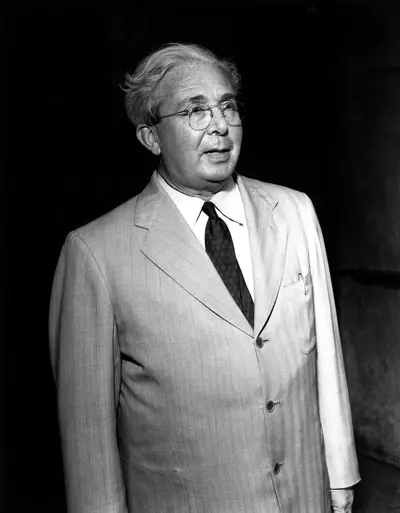
Leo Szilard was a Hungarian-American physicist and inventor. He conceived the nuclear chain reaction in 1933, patented the idea of a nuclear fission reactor in 1934, and in late 1939 wrote the letter for Albert Einstein's signature that resulted in the Manhattan Project that built the atomic bomb. According to György Marx he was one of the Hungarian scientists known as The Martians.
