Mikhail Gorbachev Quotes
Is it an American pen? In that case, I will use it.
Johnson answered, “No, it is a Mont Blanc.” The President was about to sign the historic document ending the Soviet Union and resigning, but couldn’t find a pen. Johnson offered his. The President, sensitive to the symbolism of the momentous event, checked the manufacture first.
Mikhail Gorbachev, Russian President, Dialogue with American Reporter Tom Johnson, 1991
Sourced by: Eigen's Political and Historical Quotations


Russia, from the old Soviet Union days, had the only gas pipeline into Lithuania and took advantage of their monopoly by charging the Lithuanians 15 percent more than they charged other European nations where the Russians had some energy competition. The Lithuanians, decided to tie up a very large vessel at an island in their harbor to which Liquid Natural Gas (LGN) could be delivered by ship and converted to gaseous form and piped onto the mainland to provide competition for the Russians. However, the island was a bird sanctuary that was not supposed to be used for anything that might change the ecological balance of the island. This quotation shows that in some circumstances, environmentalists are willing to compromise to balance the benefits and costs.

He served as a liaison with the Russian military officers after WWII. As a result he developed friendships with some who told him much about Stalin and the Communist party of the Soviet Union.


Kennedy had gone to West Berlin in the midst of the Cold War and the worst of the Berlin Wall. This quotation was a great example of symbolism in politics. His presence. his delivery of the line in German, the statement identified him personally and the United States with the Berliners who were surrounded by Russian dominated East Germany, endeared him to Berliners, Germans, Europeans and freedom loving people the world over even though he stated no policies, goals, or programs. His identification said it all.

This was an amazing prediction for the time. Most Europeans were not sure that the United States would even survive, and Russia was looked upon as the most backward nation in Europe. By the middle of the 20th century—over 100 years after Tocqueville wrote this—The United States and Russia were the two superpowers of the world.

The then Attorney General had established a back channel to the Russian agent. There was genuine fear by the Russians and some in America that there were still many Nazis and German nationalists who would try and influence, if not take over, German politics to produce another aggressive German fascist state. The Russians had lost 22 million citizens to the Germans in the war and had faced a defeated Germany where virtually every German over the age of 30 had been cheering for and supporting Hitler a decade ago. Neither the Russians nor we and the other allies had not yet seen the remarkable turn-around that the German nation would make and the intense anti-fascist, non-military ethos that would be brought by the younger German generations. The direction of Germany was then very unpredictable.

Nasser was indeed planning an attack. Israeli intelligence had discovered it, and the Israeli’s informed President Lyndon Johnson who in turn called Kosygin. Nasser and the Arabs had miscalculated again and ended up being not only defeated in the war they wanted but totally embarrassed by the incredibly poor performance of the Arab armies who greatly outnumbered the Israelis but had no stomach for a fight.

1st Earl Lloyd-George of Dwyfor. This turned out to be one of the worst predictions in political history.


During the Cold War and afterwards many Americans attributed the problems we were having with the Soviet Union emenated from the fact that they were Communists, and our focus was anti-communism. Kennen, however argued that it was not Communism that was the cause of the Aggression of the Soviet Union. It was an extension of the Russian Culture. After the Soviet Union collapsed, and Communism was rejected by the Russians, we still had a great deal of Russian aggression and Foreign Policy problems with Russia. Kennan was right. It was the Russian culture, history, values and traditions that were the primary cause of most of the problems with Russia.
This was more than a decade after the fal of the Soviet Union.

1st Viscountess Snowden. See Winston Churchill regarding the most famous use of the “iron curtain” phrase {411311}. She seems to have been an earlier user. The phrase " iron curtain" was used by T. St. Vincent Wallace Troubridge a few months earlier than Churchill. Also, it appears to have been used earlier than that by Nazi Propaganda Minister Joseph Goebbels in Das Reich {601664}. But George Washington Crile used the phrase in a political context in 1915 {598870}. And Viscountess Snowden used the phrase in her memoirs of a Past WWI trip to Russia {616546}. It is not known whether Troubridge or Churchill were familiar with any of these other works.
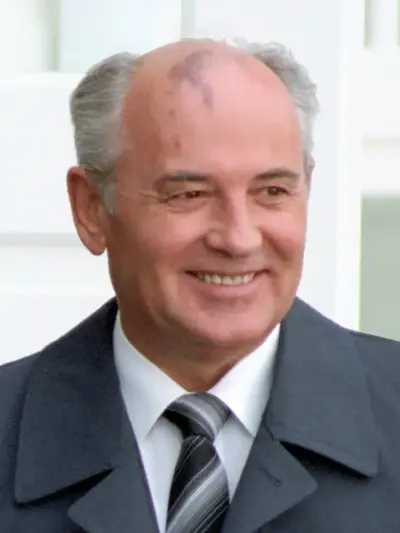
Mikhail Sergeyevich Gorbachev is a Russian and former Soviet politician. The eighth and last leader of the Soviet Union, he was the General Secretary of the Communist Party of the Soviet Union from 1985 until 1991. He was also the country's head of state from 1988 until 1991, serving as the chairman of the Presidium of the Supreme Soviet from 1988 to 1989, chairman of the Supreme Soviet from 1989 to 1990, and president of the Soviet Union from 1990 to 1991. Ideologically, Gorbachev initially adhered to Marxism–Leninism, although he had moved towards social democracy by the early 1990s.
