Anglo-Saxon Chronicle Quotes
In this year, fierce, foreboding omens came over the land of Northumbria. There were excessive whirlwinds, lightning storms, and fiery dragons were seen flying in the sky. These signs were followed by great famine, and on January 8th the ravaging of heathen men destroyed God's church at Lindisfarne.
Note that the learned men who wrote the Chronicle accepted the notion that “fiery dragons were seen flying in the sky”. In another 1000 years, who knows what we observe today that will be laughed at by our progeny. The quotation also demonstrates that historical primary sources are not necessarily reliable because they were sometimes written by men and women with primitive outlook who accepted certain things without critical analysis.
Anglo-Saxon Chronicle, Annals in Old English chronicling the history of the Anglo-Saxons, Entry for the year, 793
Sourced by: Eigen's Political and Historical Quotations


Flaccus

These lines were often quoted by British leaders during the dark days of the beginning of WWII.


In the early stages of Islam, Muhammad had hoped to convert the Jews and others on the Arabian Peninsula. When they refused to be converted, he warred against them usually killing the men, and taking the women and children as slaves. The result was that non-believing tribes were “cleansed” from the Arabian Peninsula. The Muslims at the time preferred children as slaves. For then they could convert the children against their will. Adults in Islam must accept Islam in order to convert. Children are regarded as having no such maturity of decision making and therefore opposition to conversion may be ignored and they may be forced. Critics of Islam and those who argue that Islam is at odds with all other religions point to this quotation. They claim that it is the only religion whose founder and fundamental scriptures demand war against others for no other reason than that they believe in a different religion. The Catholic Church during the Crusades and the Inquisition had a similar philosophy as did Christian missionaries colonizing Africa later. One difference is that most Christians today repudiate the doctrine as against the true spirit and teachings of Christ and view it as historical error, while very few modern Muslims repudiate this quotation of the Prophet.


Some scientists are religious believers. Many are not. However, relatively few hold the position that Dawkins does that religion is and has been an evil force in the world. These argue that religions and religious factionalism has caused as many deaths as epidemics and pandemics and is an evil for society. While that argument has been historically true in much of the world, religious conflict deaths has actually decreased in frequency over the last century and may be at a world-wise low as a percentage of the world population. With the exception of Islamic fundamentalist extremism, there is no religious group that advocates religious violence and has a majority of any country. Moderate Muslims have never before been in greater numbers, so it can be argued that modern society and most religions have been reforming themselves over the years.

This quotation illustrates that the Muslim conquest and attempt to destroy and desecrate the symbols of other religions was not limited to Christianity—it was ALL other religions. In that sense, Christianity and Islam of the period were very similar at the time—intolerance to the point of murder and destruction of any “heathen” religion.

This quotation so impressed Thomas Jefferson that he wrote it in his Commonplace Book.


See {639434}, {639436}, and {639437} for the triggers to this report.

The Netherlands and Belgium then belonged to Spain. However, Protestantism was spreading to the Netherlands. The Duke was a Catholic fanatic and advised the King to send him and an army into the Lowlands to root out and kill the heretics. In contrast, the Duke of Feria counseled allowing the lowlands tolerance. The King, himself a bloody fanatic sent Alba with the army. Over the next decade he murdered and executed thousands of Protestants and many Catholics who were more tolerant and thought Alba, who was given the derogatory nickname of “The Iron Duke. Ironically, this led to the Lowlands revolting and gaining independence from Spain.

Everyone could see the First World War coming, but the government leaders and diplomats were not able to prevent it.


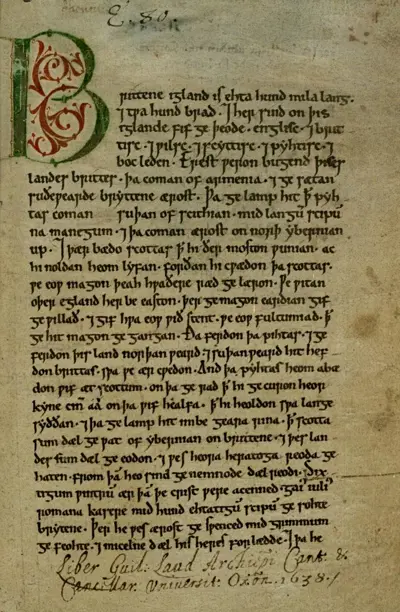
The Anglo-Saxon Chronicle is a collection of annals in Old English, chronicling the history of the Anglo-Saxons. The original manuscript of the Chronicle was created late in the 9th century, probably in Wessex, during the reign of Alfred the Great (r. 871–899). Multiple copies were made of that one original and then distributed to monasteries across England, where they were independently updated. In one case, the Chronicle was still being actively updated in 1154.
