Keshub Chunder Sen Quotes
In carrying out the work of female education great impediments, some of them of an almost insuperable character, had to be overcome, and many defects had to be rectified
Keshub Chunder Sen, 1838-1888, Indian religious and social reformer, Speech, East India Association, London, May 13, 1870
Sourced by: Eigen's Political and Historical Quotations


Most Islamic fundamentalists oppose the education of girls. Malala Yousafzai as a teen ager spoke out encouraging girls to go to school. This offended some of the Taliban fundamentalist terrorist, who threatened her if she continued to speak out. When she continued, they tried to murder her. They shot her in the head, but she was airlifted for medical treatment and survived. She was the winner of the European Sakharov Prize for Freedom of Thought and nominated for the Nobel Prize.
She was instrumental in outlawing slavery and two years after this speech she and her daughters appeared in public without the traditional Burka or veils. The conservative fundamentalists were outraged and they deposed her husband and her modern influence ended.


He was very conservative in almost all things, but here and with poverty (see {638805}) he was far ahead of his time.


This remarkable statement was written in about 1840 and there was probably then few people of either gender who would think such a thing possible.


In contemporary Iran, no one has any freedom in the International and Western sense of freedom. There is no freedom of speech, freedom of assembly, freedom of the press, freedom of religion, freedom to travel, freedom of the press, freedom of dress, or other fundamental freedoms of not only the West but the United Nations Declaration of Human Rights. However, within those restrictions, women tend to be treated more equally than in other Islamic Middle Eastern nations. Not completely equal as they have many additional restrictions that males do not have, but they can work, freely, teach and hold some positions of responsibility and power which women may not do in much of the Islamic world.

Marcus Porcius Cato. This quotation has had two different interpretations over time. One was that women if they received equality of treatment and voting would have an advantage for they also had their traditional “feminine wiles” and their sexuality, hence would dominate men. The second was a also a warning but based on the fact that women were superior in many ways, and given an equal chance, would excel men. The later interpretation is argued by some who point to the 2011 American data that shows more females than males graduating from high school and college, and females outnumber males in medical, law and several other professional schools. With the exception of a few Roman men, most heeded Cato’s warning and never took a chance on female equality.
There are two things that make this quotation interesting, First it tells us about the educational gender discrimination in early Massachusetts. But not his phrase “light soon broke in”. He obviously saw the lack of education for girls as undesirable and unenlightened. But the fact that he had this attitude and would express is so readily in 1857 tells us that, at least in the Northeast girls’ education was assumed by many as part of civilized society.
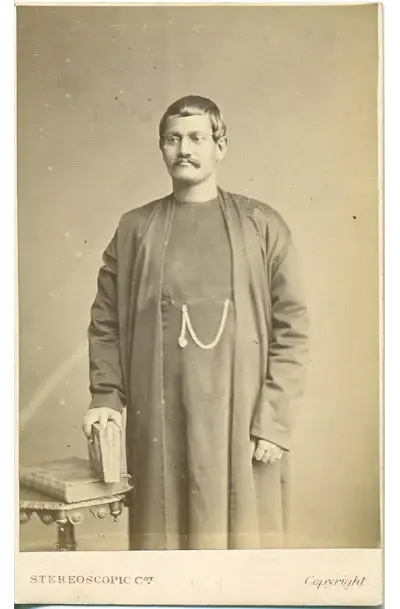
Keshub Chandra Sen was a Hindu philosopher and social reformer who attempted to incorporate Christian theology within the framework of Hindu thought. Born a Hindu in the Bengal Presidency of British India, he became a member of the Brahmo Samaj in 1857 but established his own breakaway "Bharatvarshiya Brahmo Samaj" in 1866 while the Brahmo Samaj remained under the leadership of Debendranath Tagore (who headed the Brahmo Samaj till his death in 1905). In 1878 his followers abandoned him after the underage child marriage of his daughter which exposed his campaign against child marriage as hollow. Later in his life he came under the influence of Ramakrishna and founded a syncretic "New Dispensation" inspired by Christianity, and Vaishnav bhakti, and Hindu practices.
