Karl Marx Quotes
In bourgeois society capital is independent and has individuality, while the living person is dependent and has no individuality.
Marx, Karl, and Frederick Engels. Manifesto of the Communist Party. Charles H. Kerr & Company, 1906, p. 35.


See Howard Zinn, 1922-2010 {38477} for a later, narrower view with respect to America.


He was a strong opponent of communism (see {586209} and {586210}) but was also skeptical of unbridled capitalism.


Labor unions as we know them did not then exist. Calhoun and many others saw the struggle as a inherent class struggle, not unlike that particular view of Karl Marx. See {606584} for one his more extreme views on the subject.


The United States money was then on the Gold Standard. The country was growing and needed more money in circulation. But most of the gold that might be available was in England and English bankers could control much of the U. S. economy. The Populists and the Democrats wanted us to use silver to back U. S. money as there was plenty of silver in the United States. The Republicans would not relent and depression was upon the country. A half century later, it would be Republican President Richard M. Nixon, who took the United States off the gold standard. Lease was far ahead of her time.


This novel won the Booker Prize—one of the great achievements in literature.

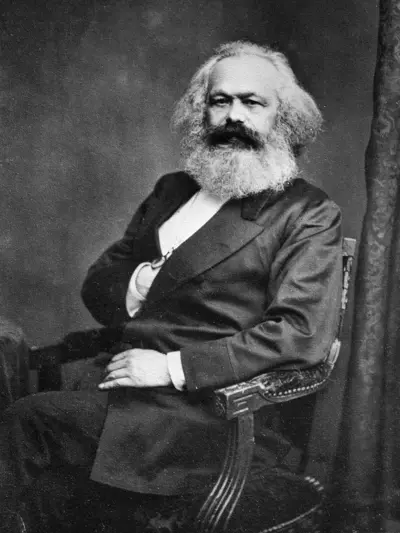
Karl Heinrich Marx was a German philosopher, economist, historian, sociologist, political theorist, journalist and socialist revolutionary. Born in Trier, Germany, Marx studied law and philosophy at university. He married Jenny von Westphalen in 1843. Due to his political publications, Marx became stateless and lived in exile with his wife and children in London for decades, where he continued to develop his thought in collaboration with German thinker Friedrich Engels and publish his writings, researching in the reading room of the British Museum. His best-known titles are the 1848 pamphlet The Communist Manifesto and the three-volume Das Kapital (1867–1883). Marx's political and philosophical thought had enormous influence on subsequent intellectual, economic and political history. His name has been used as an adjective, a noun, and a school of social theory.
