Paul Conrad Quotes
Throughout our history - and that of the world - it's always come down to the friction between the haves and have-nots or between the average Joes and the large corporations. So that's a recurring theme in my work.
Paul Conrad, 1924–2010, Political Cartoonist, Quoted in Longden, T., “Famous Iowans - Paul Conrad”, The Des Moines Register, March 25, 2009
Sourced by: Eigen's Political and Historical Quotations

Diamond’s observation refers to major technologies like farming and ability to use metals.


Referring to the urban poverty in mid-nineteenth century Spain.

This novel won the Booker Prize—one of the great achievements in literature.


Abrams originated this famous phrase which many have been used subsequently for various “socialized” government benefits that were available to the rich but not the poor. He was referring to the fact that at the time, the government provided housing assistance to the rich by having federally insured mortgages and granting tax deductions for the interest in home mortgages, but there was no assistance to the poor who could only afford to rent and had no tax deductions nor was there any federal public housing assistance. During the Great Recession the phrase was often used when the government gave bail out money to General Motors and the largest banks who were close to bankruptcy, but the landscaping gardener or the hot dog vendor whose business was falling because of the recession were told that is the capitalist system—there are some winners and some losers. The government officials who advocated the bailout did not disagree about the fairness and appropriateness of the Abrams phrase but if they had not bailed the banks out, the entire economic system of the country would probably have collapsed and the ensuing depression would hurt the average worker and the poor even more. Related to the recent “too big to fail” concept.


After Roosevelt, most eras of American politics more or less followed the pattern Roosevelt described herein as a “calamity”, with the anger becoming more or less intense. Jefferson thought that these were natural divisions of politics in all societies--{604810}. The thing that masked this for years was race and slavery. In Lincoln’s time there were liberals and conservatives in both parties if race were ignored. In Theodore Roosevelt’s era, he, Taft and others were generally liberal reformers, while a large number of Republicans were conservative supporters of the status quo. Some democrats were radical reformers like William Jennings Bryan while others were arch conservatives. Until 1964 and the Civil Rights Act there were many conservatives in the Democratic Party, but almost all switched to the Republican Party in anger. The Republican conservatives tended to drive the Republican liberals out of the party and for the last part of the 20th century Roosevelt’s “calamity” well described the American political scene, and the anger increased carrying partisan bitterness into the 21st century.


By 2015, the income inequality had gotten so bad that even billionaires were expressing alarm.


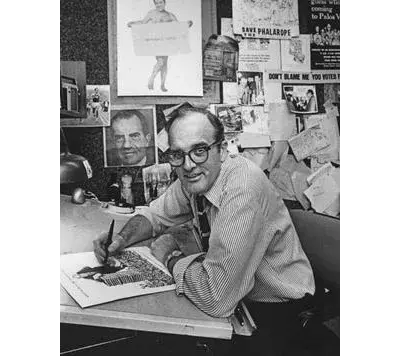
Paul Francis Conrad was an American political cartoonist and winner of three Pulitzer Prizes for editorial cartooning. In the span of a career lasting five decades, Conrad provided a critical perspective on eleven presidential administrations in the United States. He is best known for his work as the chief editorial cartoonist for the Los Angeles Times during a time when the newspaper was in transition under the direction of publisher Otis Chandler, who recruited Conrad from the Denver Post.
